
Insurance CRM ROI: Cost-Benefit Analysis and How to Measure Long-Term Business Value
Key Takeaways:
- Insurance CRM ROI has to be measured, not assumed. It is proven by comparing what the platform actually costs against the gains it actually produces over time.
- Legacy, cloud-based, and AI-enabled policy administration systems each solve different problems. Most carriers run a combination of all three, modernizing module by module rather than in a single cutover.2027’s defining shift: agentic AI, real-time data, and AI governance move from pilot projects to standard operating requirements.
- Core modernization projects still underdeliver after go-live when ownership of the engineering work lapses the moment vendors and implementation partners step away.
What does an insurance CRM actually deliver, and how would most agencies know whether it’s paying off?
Spending on these platforms keeps climbing. The insurance CRM software market was valued at $11.25 billion[1] in 2025. It is estimated to reach $16.64 billion by 2033, growing at a 5.0% CAGR. Agencies are clearly buying, configuring, and deploying CRMs. But purchasing a CRM and profiting from one are two very different things.
It’s easy to see why this distinction gets lost. Vendors lead with feature lists. IT teams focus on implementation timelines. Leadership signs off assuming the returns will follow. But insurance CRM ROI does not arrive automatically. It has to be built, tracked, and proven.

That means making two cases at two different moments. Before purchase, an insurance CRM cost-benefit analysis justifies the spend. After go-live, ROI measurement proves the spend was worth it. Many agencies make the first case and never get to the second.
That is what this blog addresses. It walks through what an insurance CRM costs, the returns it generates, and how to calculate ROI with a working formula. It then details the KPIs to track after go-live, the challenges that make ROI hard to prove, and the practices that protect long-term business value.
What Does It Cost to Implement an Insurance CRM?
Insurance CRM implementation costs span six categories. These include licensing, implementation, integration, data migration, training, and ongoing maintenance. The total cost varies widely with agency size, the platform chosen, and how complex the existing technology stack is.
The sections below explain what drives each cost, so an agency can build an estimate that reflects its own size and systems.
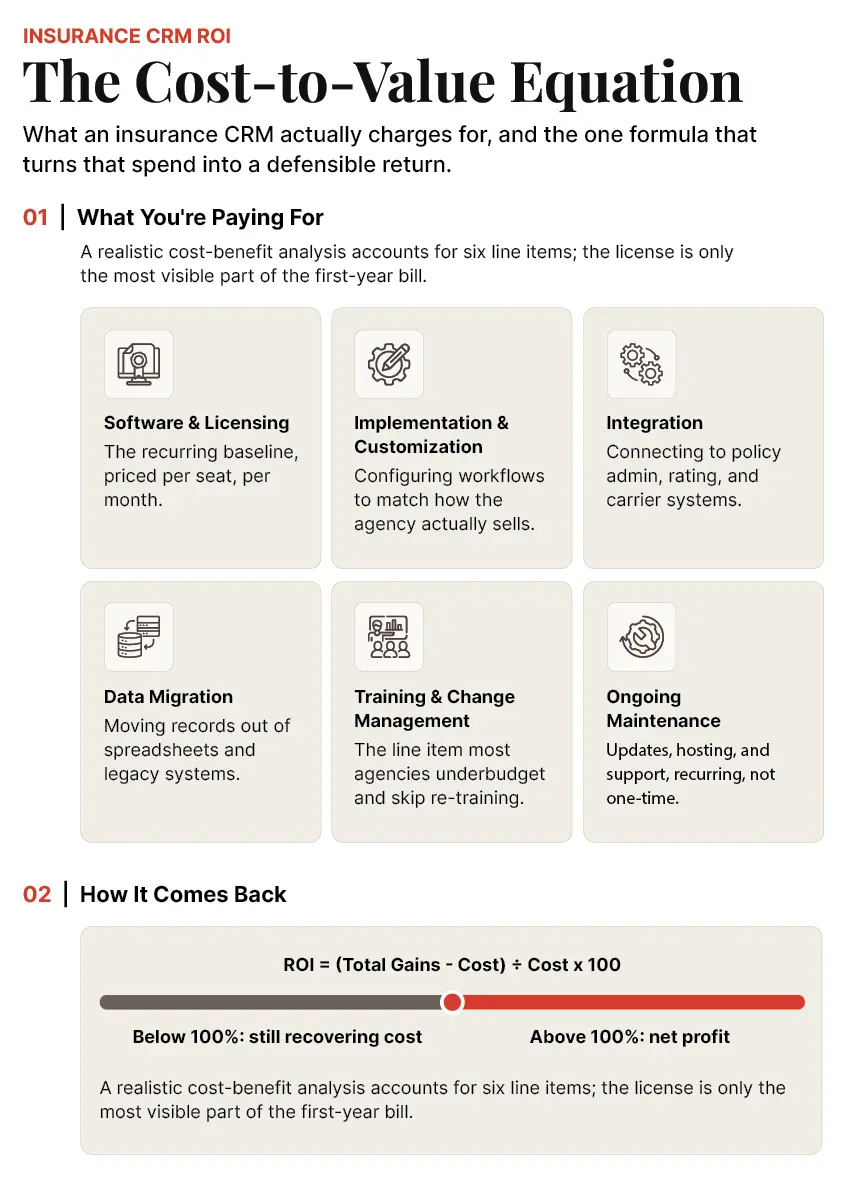
1. Software and Licensing Fees
Monthly subscription fees form the baseline. But this baseline shifts quickly once the number of users and feature requirements come into the picture. Entry-level and mid-tier plans cover core contact and pipeline management, while premium tiers with advanced analytics, AI features, and API access cost considerably more per seat.
The math catches agencies off guard. Per-seat pricing multiplies with every user added, and annual contracts, minimum seat counts, and paid add-ons push the real bill well past the headline per-seat rate vendors quote in their pitch decks.
2. Implementation and Customization Expenses
Configuration work that aligns the CRM with agency workflows, policy types, and sales processes adds a layer of expenses that rarely appear in early conversations with vendors. The further an agency’s processes depart from the platform’s defaults, the larger this cost grows. Customizing dashboards and embedding new data fields incurs additional developer fees. A phased insurance agency CRM implementation roadmap helps keep this line item from expanding mid-project.
3. Integration with Existing Systems
Connecting the CRM to policy administration systems, rating engines, and carrier portals demands budget headroom. A single, well-documented API connection is straightforward. Syncing two-way data between databases adds complexity and cost. Integrating the CRM with a legacy policy admin system is the most expensive tier, demanding custom middleware on top of the integration work.
This cost scales with three things: how many systems need connecting, how well-documented their APIs are, and how old the systems on the other end are.
4. Data Migration Costs
Moving policyholder records, notes, and history out of spreadsheets or a legacy system isn’t a one-click export. Cost rises faster than record count, because messy data takes disproportionately more work to clean, de-duplicate, and map. The volume of records, the number of source systems, and the condition of the data together set the final cost.
Data quality problems that look manageable on a spreadsheet become expensive problems when moving into a structured CRM environment, so it’s worth auditing data quality before migration begins.
5. Training and Change Management
This is the line item agencies often underbudget. Initial training costs scale with headcount and with the number of roles that need their own workflows, and that’s before accounting for ongoing enablement as staff turns over.
Organizations already working on a similar platform can reduce this cost by leaning on existing familiarity, but most still underestimate how much behavioral change a new CRM demands.
6. Ongoing Maintenance and Support
Beyond the subscription fees, someone must manage admin tasks, apply updates and security patches, cover cloud hosting, and maintain the integrations built during rollout. Priority or dedicated support is also a paid tier above the base license. Unlike the one-time costs mentioned earlier in this section, maintenance is recurring by nature, which is why it is often overlooked while planning the budget.
Add these six categories together and the first-year investment lands well above the subscription fee alone. No single benchmark fits every agency, so an agency-specific estimate across all six is the only reliable anchor for any CRM cost analysis. Before asking what a CRM returns, an agency should know what it will spend.
What Are the Benefits of an Insurance CRM?
The main insurance CRM benefits are:
- time saved for agents
- faster policy processing
- fewer data errors
- stronger retention
- shorter sales cycles
- more cross-sell revenue
Each one maps to a metric an agency can track, and that is what turns a benefit into a return.
The costs in the previous section buy operational change. The benefits below are only worth counting if they show up in numbers an agency can track and defend. For a feature-by-feature view, see insurance CRM features and benefits.
I. Time Saved and Broker Productivity
Before a client conversation even starts, agents often toggle between the policy admin system, a claims platform, and email threads to piece the account together. A CRM integrated with those systems brings policyholder records into one view. Staff can then open every interaction with full context instead of asking the client to confirm a policy number.
Routine work goes next. Automation in insurance CRMs assigns leads, triggers follow-up tasks, logs activity, and flags renewal dates without manual input. Agents stop chasing dates and details and step in only when a situation needs human judgment.
That shift is the source of broker productivity gains: the same team can manage more policies without adding headcount. It’s also where most CRM cost savings in insurance agencies come from.
Measure it by: administrative hours per agent per week and policies managed per agent, compared against the pre-CRM baseline.
II. Faster Policy Processing and Underwriting Turnaround
A CRM doesn’t underwrite risk, but it shapes how quickly and cleanly work reaches the people who do. When client data, prior policies, and documents already sit in one record, agencies can assemble complete submissions without chasing missing details. Complete submissions spend less time in back-and-forth with underwriters, which cuts policy processing time and improves underwriting efficiency on the carrier or MGA side.
For insurers running a CRM alongside their own underwriting systems, the same effect appears as underwriters starting from a full customer history rather than a partial one.
Measure it by: average policy processing time from submission to issuance, and the share of submissions returned for missing information.
III. Fewer Errors and Cleaner Data
Every time the same policyholder detail is retyped into another system, the chance of a mismatch rises. A CRM captures data once and, when integrated, passes it to downstream systems. This reduces duplicate records, transposed numbers, and outdated contact details. Cleaner client records also mean more accurate information at first notice of loss, which supports claims accuracy downstream.
Measure it by: duplicate-record rate, data-correction requests, and the share of policy or claims records that need manual fixes.
IV. Stronger Customer Retention
Retention is where CRM investment tends to pay its clearest dividend. The CRM flags every policyholder approaching renewal, segments accounts by line and tenure, and triggers outreach well before the renewal window closes. AI-enabled platforms can also score churn risk, so at-risk accounts get attention first.
Measure it by: customer retention rate and policy renewal rate by segment.
V. Shorter Sales Cycles
In personal lines especially, prospects shop around before they commit. Auto insurance shoppers now receive an average of 3.5 quotes, the highest level in the 20-year history of J.D. Power’s U.S. Insurance Shopping Study. [2]
The agency that follows up first, and follows up consistently, has the edge. Structured pipelines and automated follow-up give every lead timely outreach, so prospects move from first quote to bound policy faster.
Measure it by: time from first contact to bound policy, and lead-to-policy conversion rate.
VI. More Cross-Sell and Upsell Revenue
Selling an additional line to an existing client generally costs less than winning a new one, yet many agencies leave that opportunity idle. Policyholders with multiple policies also tend to stay longer, so cross-sell supports retention as well as revenue.
A CRM surfaces coverage gaps in each client’s portfolio. AI-enabled platforms can also score likelihood to buy based on existing policies and life events, prompting agents at the right time. Cross-selling then stops depending on individual agents remembering to ask.
Measure it by: policies per household or account, and revenue from existing clients.
How Do You Calculate Insurance CRM ROI?
Insurance CRM ROI is calculated by subtracting the total cost of the CRM from the total gains it produces, dividing the result by total cost, and multiplying by 100. Any result above 0% means the CRM has returned more than it cost.
1. Total Investment Costs vs. Measurable Gains
Getting the formula right depends on getting both sides of it right first. Most agencies get the cost side wrong by leaving line items out, then wonder why the ROI number does not hold up to scrutiny.
The two sides mentioned below are not symmetric by accident. Every cost category has a corresponding place it is meant to pay off. Leave training or integration off the cost side, and the gains look inflated. Leave retention or admin-time savings off the return side, and the CRM looks like it is underperforming when it isn’t.
| Total Investment (Cost Side) | Measurable Gains (Return Side) |
|---|---|
| Annual subscription fees | Reduced administrative time from automatic logging |
| Implementation and customization | Shorter quote-to-bind time and higher premium per account |
| Integration with policy admin and rating systems | Fewer overlapping tools and less manual reporting |
| Data migration from legacy platforms | Repeat and upsell revenue from existing policyholders |
| Staff training programs | Higher close rates from structured pipelines and automated follow-up |
| Ongoing maintenance contracts | Retention gains from proactive renewal outreach |
2. The ROI Formula in Practice
The standard formula is simple:
ROI (%) = [(Total Gains from CRM – Cost of CRM) / Cost of CRM] × 100
Total gains are everything the CRM generates in a period. This includes labor hours saved, additional cross-sell and renewal revenue, reduced policy-lapse costs, measured against what it costs to buy, implement, and run.
To see how the formula itself works, take a simple hypothetical: say an agency spends X in its first year, and the CRM generates 1.5X in measurable gains across labor savings, cross-sell revenue, and reduced policy lapses.
ROI = [(1.5X-X) / X] × 100 = 50% first-year ROI
This is just a hypothetical walkthrough of the calculation. Actual gains depend on adoption, integration quality, and how disciplined the agency is about tracking the KPIs, which are discussed in the next section.
Which KPIs Should Be Tracked for Measuring CRM ROI After Implementation?
The insurance CRM performance metrics that agencies need to track include customer acquisition cost, lead-to-policy conversion rate, retention rate, customer lifetime value, sales productivity, renewal rate, cost per transaction, and revenue per agent.
“Measurement is the first step that leads to control and eventually to improvement. If you can’t measure something, you can’t understand it. If you can’t understand it, you can’t control it. If you can’t control it, you can’t improve it.”
– H. James Harrington, Author and Business Consultant
| KPI | What It Measures | Why It Matters After Go-Live |
|---|---|---|
| Customer acquisition cost (CAC) | Total sales/marketing spend divided by new policyholders acquired | Should trend down as lead qualification and follow-up become automated rather than manual |
| Conversion rate | Share of leads that become paying policyholders | A CRM’s lead-scoring and nurture workflows should lift this over time |
| Customer retention rate | Share of policyholders retained over a period | Retention is where top-performing agencies separate themselves from the rest, and a CRM’s renewal and service triggers are a direct lever here. |
| Customer lifetime value (CLV) | Total revenue expected from a policyholder relationship | Should rise as retention and cross-sell both improve |
| Sales productivity | Output (quotes, binds, revenue) per agent or per hour worked | Should trend up as automation removes non-selling admin work |
| Lead-to-policy conversion | Share of leads that convert all the way to a bound policy | A CRM’s pipeline visibility should shorten the funnel and lift this rate |
| Policy renewal rate | Share of expiring policies successfully renewed | Should trend up with proactive, CRM-triggered renewal outreach |
| Cost per transaction | Operating cost divided by number of policy transactions processed | Should trend down as manual, duplicate work is removed |
| Revenue per agent | Total revenue divided by number of producing agents | A CRM should help agents move toward the top end of their agency’s typical range by supporting more accounts per person |
Track these metrics monthly for the first 90 days, then quarterly after. A single good month doesn’t confirm ROI, but a consistent trend across two or three quarters does.
How Can Agencies Measure Long-Term CRM Business Value?
Demonstrating CRM business value comes down to comparing baseline metrics against 3-, 6-, and 12-month results across productivity, revenue, and customer experience indicators.
I. Setting Baseline Metrics Before Implementation
Before the CRM goes live, write down where things stand today: customer acquisition cost, retention rate, sales cycle length, and any other KPI worth tracking. Most agencies skip this step, then cannot prove results later. Document how each metric is calculated and which system it comes from, then use exactly the same method after launch. Changing methods mid-stream makes the comparison meaningless.
II. 3-Month, 6-Month, and 12-Month Performance Comparisons
Compare results against the baseline at three fixed checkpoints. Each one answers a different question.
At three months, the question is adoption. Agents have moved past the learning phase, so early efficiency signals such as lead response time should start moving. At six months, look for trends. Retention and sales-cycle length have had enough time to show a pattern that isn’t just early noise. At twelve months, the agency has a full renewal cycle of data, which gives a reliable read on revenue, retention and overall ROI.
III. Tracking Productivity and Revenue Trends Over Time
Watch for specific operational signals, not broad revenue summaries: shorter quote-to-bind times, fewer errors in the sales process, and new agents reaching their first sale faster. These are the clearest evidence the CRM is actually changing how work gets done. Track them quarterly and tie each one back to the workflow it affects. When a number stalls, you will know where to look.
IV. Measuring Customer Experience Improvements
Customer experience is where CRM value eventually shows up at the bottom line.
Track it on two levels: operational signals like retention, response time, and first-contact resolution, and sentiment signals like CSAT and NPS that reveal whether policyholders feel the difference.
Together, these four practices turn CRM value from a claim into evidence. Build the structure before launch, and proving long-term value gets far easier than reconstructing it after the fact.
What Are the Common Challenges in Measuring Insurance CRM ROI?
Common challenges include missing pre-implementation baselines, hard-to-quantify qualitative benefits, siloed data across departments, and measurement windows that are too short to be reliable. These obstacles follow predictable patterns, and most of them begin before the system goes live.
1. No Pre-Implementation Baseline Captured
Many agencies implement a CRM and three months later cannot say whether it worked, because nobody recorded the original lead conversion rate, sales cycle length, or data quality before launch. Without that baseline, improvement is nearly impossible to prove. The CRM might be working as intended, but there is no story to tell. Organizations that skip this step end up defending a system they cannot validate.
2. Qualitative Benefits That Resist Quantification
Better team morale, stronger cross-department collaboration, and less stress from fewer manual tasks all carry real value. But putting a dollar figure on any of them is a different problem entirely. These benefits are genuine. Leaving them out of the ROI number does not mean the CRM is underperforming. It just means the full picture is harder to present to leadership accustomed to clean numbers, and real gains risk getting discounted simply because they do not fit a spreadsheet.
3. Siloed or Inconsistent Data
When policy administration, marketing, and the CRM operate on different data definitions, inconsistent records follow. The result? Conflicting reports that undermine organizational confidence in the numbers. When people cannot trust the data, they stop acting on it. Dashboards get reviewed in meetings and then quietly ignored.
4. Measurement Windows That Are Too Short
Evaluating CRM results after four weeks is premature. The first month is adaptation. Agents are still learning where things live, building new habits, and working around unfamiliar workflows.
The minimum honest evaluation window is three months, and a full picture rarely emerges before six months. Agencies that declare failure at week six are not measuring CRM performance. They are measuring the discomfort of change.
How Can Agencies Maximize the ROI of Their CRM Investment?
Agencies maximize CRM ROI by setting KPI targets early, assigning an ROI owner, reviewing adoption monthly, integrating core systems, and revisiting workflows quarterly.
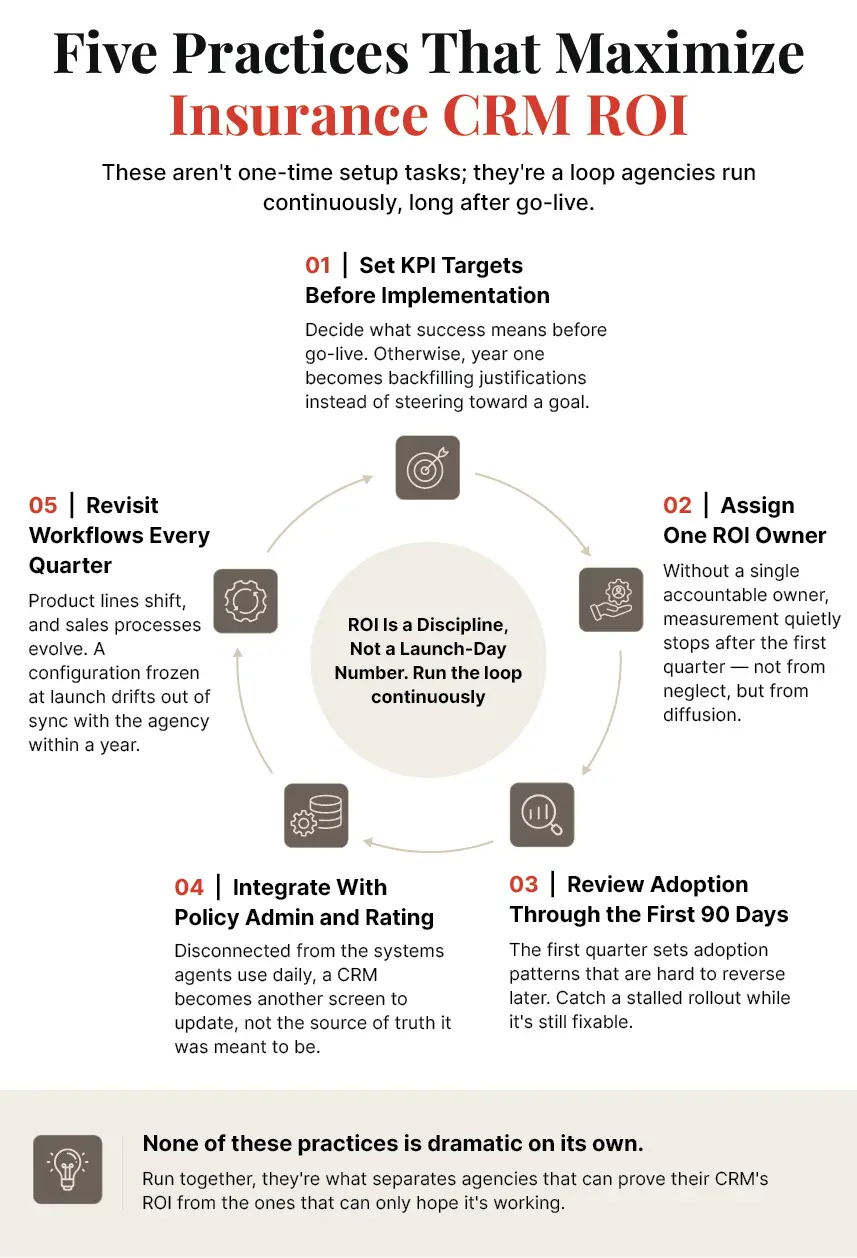
I. Set KPI Targets Before Implementation, Not After
It is critical to define what success looks like before the system goes live. This sounds obvious, but most agencies skip it.
Establishing specific, measurable goals aligned with business objectives provides clear benchmarks that hold the investment accountable. Deciding targets after implementation means backfilling justifications instead of steering toward an outcome. That distinction matters enormously when leadership questions the CRM’s ROI.
II. Assign an ROI Owner
Without one person accountable for tracking adoption, KPIs, and ROI calculations, measurement quietly stops after the first quarter. Nobody is ignoring the data out of negligence. The work falls through the cracks when ownership isn’t clearly assigned to one person.
That owner should talk to users about friction points slowing them down. These conversations surface problems that dashboards never will: the step everyone skips, or the feature nobody trusts yet.
III. Review Adoption Monthly in the First 90 Days
The first 90 days determine long-term success. Not the first year. Not the six-month mark.
It’s important to measure login frequency, feature utilization rates, data quality by team, and time spent in the system within the first three months. Early adoption checks catch stalled rollouts while they remain fixable. Waiting until the six-month review to discover that half the team bypassed the CRM is a much harder problem to fix.
IV. Integrate with Policy Admin and Rating Systems
Operational benefits materialize only when the CRM integrates with policy administration, claims, and billing systems. A CRM that sits disconnected from the systems agents actually use every day will be treated as a parallel task, not a central workflow.
Without integration, duplicate data entry undercuts every efficiency gain the platform was supposed to deliver. And the CRM becomes another screen to update rather than the single source of truth it was designed to be.
V. Revisit Workflows Quarterly Rather Than “Set and Forget”
A CRM is a living system. The configuration that made sense at launch will not perfectly match the business twelve months later. Product lines shift. Sales processes evolve. Carrier relationships change.
Workflows need quarterly reviews to stay aligned with how the business actually operates. Businesses that treat the initial implementation as the finish line consistently underperform those that treat it as the starting point.
Conclusion
Insurance CRM ROI isn’t a number you calculate once at go-live. Costs show up right at the start, but the returns take months to build. That’s why tracking a baseline and checking progress at regular intervals matters far more than a single estimate made on launch day.
Agencies that treat ROI as an ongoing habit, not a one-time report, get more out of the CRM in the long run. They catch problems early instead of discovering them a year later, and they keep building on what’s working instead of letting those gains quietly slip away.
References:
- [1]: Verified Market Research
- [2]: JD Power
Read more from our blog
Tell us what you're working on
A strategist reads every reply and writes back.