
Data Anonymization: A Complete Guide to Techniques, Benefits, Compliance, and Best Practices
Key Takeaways
- Data anonymization irreversibly removes identifiers, so individuals cannot be re-identified.
- Unlike masking, pseudonymization, or tokenization, true anonymization cannot be reversed.
- Balancing privacy with data utility remains the biggest anonymization challenge.
- AI teams should anonymize data before training, fine-tuning, or third-party processing.
- Effective anonymization combines multiple techniques, attack testing, and continuous monitoring.
What if an AI could figure out exactly who you are from nothing more than your posts? A 2026 study found that large language models could re-identify up to 68%[1] of anonymous online users with 90% precision, at a cost of just a few dollars per person. If stripping out names is no longer enough to protect privacy, then the way most organizations handle data has a serious gap.
Data anonymization addresses this gap while adding real business value. Protecting sensitive information is an ethical duty, but it also makes financial sense. Properly anonymized data carries far fewer legal restrictions, so organizations can analyze, share, and monetize it with confidence. It also opens opportunities that privacy laws once kept shut, from cross-border data partnerships to collaborative research that moves faster without putting users at risk.
Anonymization has thus moved from a compliance checkbox to a valuable business tool. Companies that get this right protect privacy, cut costs, and build new revenue streams.
This blog explains what data anonymization is and how it compares with data masking, pseudonymization, encryption, and tokenization. It also covers its advantages, real-world use cases, and its role in AI and machine learning.

What Is Data Anonymization?
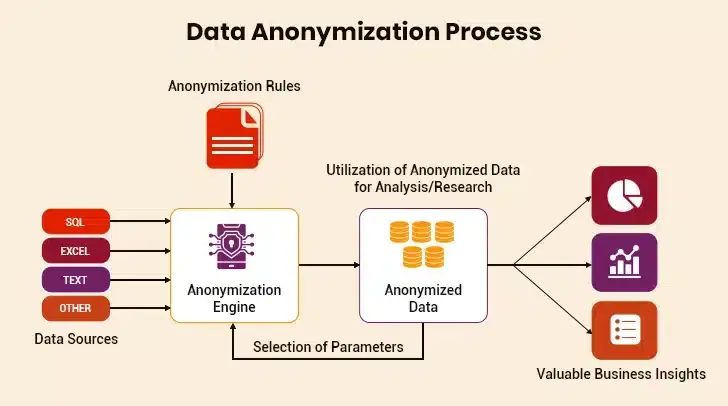
Data anonymization involves irreversibly removing or altering personal identifiers from datasets. This prevents individuals from being re-identified, even when combined with other data. It covers two kinds of attributes: direct identifiers, such as names and email addresses, and quasi-identifiers, such as ZIP code, date of birth, or job title, which can single out a person when combined. Organizations use anonymization to comply with regulations while safely analyzing sensitive customer, employee, or partner data. It reduces the risk of identity theft and fraud if there is a data breach.
Data Anonymization Techniques
Data anonymization methods range from simple substitutions to privacy models with mathematical guarantees. The right method depends on data volume, structure, and intended use.
Common data anonymization techniques include:
- Generalization: Replaces specifics with broader categories (e.g., exact ages changed to age ranges). Preserves utility while reducing identifiability.
- Suppression: Removes entire values, columns, or records that are too rare or risky to keep, such as an outlier salary or a one-of-a-kind job title.
- Data Swapping: Swaps values between records (e.g., swapping salaries across employee entries). Protects individual privacy while maintaining overall accuracy.
- Synthetic Data: Generates artificial data mimicking statistical patterns of real datasets. Enables analysis without exposing actual personal details.
- Perturbation: Adds small random changes to values (e.g., shifting dates by a few days or adjusting amounts slightly). Individual records become blurred, while averages stay close to the original.
- Differential Privacy: Adds calibrated statistical noise to query results or model training, so the output reveals almost nothing about whether any one person is in the dataset. The level of protection is set through a tunable “privacy budget”.
Data Anonymization vs. Related Data Privacy Techniques
Anonymization is often confused with other privacy methods. The key difference is whether the original data can be recovered, because that decides whether the output still counts as personal data.
- Data Anonymization vs. Data Masking
Masking hides sensitive values by substituting, shuffling, or obscuring them while keeping the format intact, so a masked card number still looks like a card number. Many masking methods are reversible or leave quasi-identifiers untouched, so masked data may still be personal data. Anonymization is broader and irreversible: it treats direct and quasi-identifiers together so that no one can be re-identified.
- Anonymization vs. Pseudonymization
Pseudonymization replaces identifiers with artificial ones (e.g., a customer ID in place of a name) and stores the linking key separately. Anyone with the key can re-identify individuals, so the General Data Protection Regulation (GDPR) still treats pseudonymized data as personal data. It is a useful security measure for long-term studies, but it does not offer the regulatory flexibility of true anonymization.
- Anonymization vs. Encryption
Encryption scrambles data, so it cannot be read without a decryption key. It protects data at rest and in transit, but anyone with the key sees the original values, and encrypted personal data remains personal data. Encrypted data also cannot be analyzed until it is decrypted, while anonymized records can be analyzed as is.
- Anonymization vs. Tokenization
Tokenization swaps a sensitive value, such as a card number, for a random token and stores the mapping in a secure vault. It is widely used in payments to reduce PCI DSS scope. Like pseudonymization, it can be reversed through the vault, so it limits exposure rather than removing identifiability.
- Businesses need to implement fewer security measures.
- The compliance burden is considerably reduced.
- Anonymized records can be stored easily.
- Measure the trade-off between privacy and data utility in monetary terms
- Pick anonymization methods that fit specific business needs
- Use approaches that combine different anonymization methods
- Linkage attacks that connect multiple datasets to expose identities
- Machine learning techniques that detect individual patterns
- External information sources that provide contextual clues
- AI models that identify sensitive attributes across datasets
- Workflow management tools that standardize processes
- Anonymization platforms that get the work done while ensuring compliance
- Prompt leakage: Employees paste sensitive customer data into public AI tools.
- Retrieval leakage: RAG systems surface documents a user shouldn’t access.
- Inference attacks: Membership inference and model inversion attacks try to determine whether a person’s record was used in training, or to reconstruct it.
- Compare model accuracy on anonymized and original data before settling on a technique.
- Apply differential privacy during training, which adds calibrated noise so the model can’t memorize individual records. Libraries such as TensorFlow Privacy support this without distorting the raw data.
- Check fairness metrics after anonymization to confirm no group is disproportionately affected.
- Revisit anonymization settings whenever the model is retrained on new data.
- Use differential privacy to add controlled random noise
- Reduce data granularity in sensitive fields
- Combine pseudonymization with other methods for data that must stay linkable internally
- Singling out one individual’s record within the dataset
- Linking records about the same person, within the dataset or across other datasets
- Inferring sensitive attributes about a person from the data that remains
- Check that key statistics, distributions, and correlations in the anonymized version stay close to the original.
- Test the data with the actual reports, test cases, or models it is meant to support.
- Homomorphic encryption lets systems run calculations on encrypted data without ever decrypting it.
- Secure multi-party computation lets several organizations analyze their combined data without any of them seeing the others’ records.
- Confidential computing processes data inside isolated, hardware-protected environments that even the cloud provider cannot access.
- [1]: arXiv
- [2]: SpyCloud
- [3]: Science Advances
Anonymization as a Business Enabler: Key Advantages
“The companies that do the best job on managing a user’s privacy will be the companies that ultimately are the most successful.”
– Fred Wilson, American businessman and venture capitalist
Anonymization provides advantages that go way beyond meeting regulations. Companies create business value through many channels. This way, privacy becomes a competitive advantage.
1. Cost Reduction and Operational Efficiency
The anonymization of data affects finances substantially. Companies can cut down on operating costs when they use data anonymization tools and techniques. These savings come from many sources:
Anonymization also speeds up data collection and analysis. Teams spend less time on compliance paperwork and more time analyzing data. That efficiency boost happens because many regulatory barriers disappear when personal data processing is removed from the equation.
2. Expanded Data Utilization and Innovation
Organizations can use properly anonymized records for analytics, product development, and marketing strategies. They can gain maximum value from this information without privacy concerns. Research shows that companies that leverage anonymization innovate much faster compared to those that do not. This gives them an advantage over their competitors.
Anonymization allows companies to share data with their partners safely. There is little risk of sensitive information falling into the hands of unauthorized users.
3. Risk Mitigation and Security Enhancement
Anonymization protects against various threats. SpyCloud’s[2] Insider Threat Pulse Report found that 56% of organizations experienced an insider threat incident in the past year. Organizations can prevent accidental exposure or misuse by authorized users through anonymization.
When security breaches happen, anonymization limits the potential damage. This is because the information cannot be used by attackers in a meaningful manner. This protection reduces immediate financial losses and prevents long-term reputation damage that follows data exposure incidents.
4. Enhanced Trust and Market Positioning
Privacy-conscious customers tend to notice companies that protect data well. Organizations that invest heavily in anonymization earn customer trust. This trust often leads to measurable business outcomes: customers feel more comfortable sharing their personal details with companies that are perceived as privacy leaders. This ethically gathered data then fuels better insights. It also helps create personalized experiences and stronger customer relationships.
5. Unrestricted Data Analysis and Storage
Anonymized records can be stored indefinitely. This allows research teams to conduct longitudinal analyses where the same individuals are repeatedly observed over a period of time. Extended timelines allow researchers to study long-term trends and patterns that provide deeper insights. This kind of information would be impossible to capture under standard data retention policies.
Since anonymized data falls outside many regulatory frameworks, teams can analyze information across broader parameters without worrying about legal issues. This regulatory flexibility empowers data scientists to pursue new analytical approaches.
Barriers to Scaling Data Anonymization and Their Solutions
Anonymization brings many benefits. However, scaling it may involve challenges. Companies need to tackle these hurdles to tap into the potential of anonymization without risking data integrity.
I. Privacy-Utility Trade-Off
The hardest part of anonymization is balancing privacy protection with data usefulness. Research suggests data can be useful or completely anonymous, but not both at once. Push privacy too far, and the dataset drifts from the original: stripping out enough predictor variables to rule out re-identification usually takes model accuracy and utility down with it.
Here’s what companies can do about it:
II. Re-Identification Risks
Remember when removing names and Social Security numbers felt like enough protection? Those days are long gone. Research shows that just four random points can identify 95%[3] of individuals within a dataset. This shows how easily supposedly anonymous data can be traced back to individuals.
Re-identification threats have been rising for the following reasons:
Businesses can combine anonymization with other data security techniques (encryption or erasure) to reduce the risk, and test for re-identification before any dataset is released.
III. Cost and Complexity of Deployment
Implementation of anonymization involves a range of challenges. Advanced anonymization techniques require specialized expertise, which most small-sized companies do not have. Also, anonymization is not a one-time exercise. It requires continuous adaptation to new types of data, emerging technologies, and the evolving threat landscape.
Data anonymization services address these issues through:
Solving these challenges allows organizations to implement enterprise data anonymization at scale while maintaining data utility. That said, effective anonymization needs constant attention as privacy threats and de-identification technologies keep advancing.
Data Anonymization Use Cases
Anonymization helps organizations turn data privacy requirements into new revenue streams. These use cases show how companies protect their data while staying profitable.
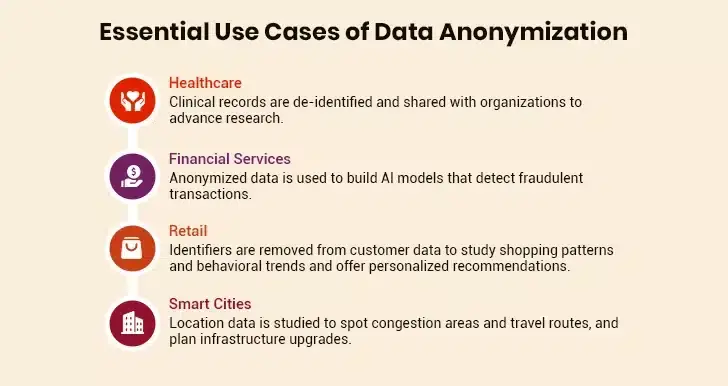
1. Healthcare: Clinical Research
Healthcare data anonymization protects patient privacy while supporting vital research. Mayo Clinic, for example, uses an AI platform to de-identify clinical records. That data helped flag early COVID-19 symptoms such as anosmia, and Mayo now shares it with healthcare innovators through its Platform Discover service. The Children’s Hospital of Philadelphia is building a similar cloud platform to give clinicians de-identified data on pediatric cancer patients for faster research.
2. Financial Services: Fraud Detection
Banking institutions use financial data anonymization to detect fraud, stripping out identifiers such as names and account numbers to analyze transactions without violating GDPR consent rules. This data trains AI systems to spot suspicious activity faster and more accurately. Banks also share anonymized fraud patterns with each other, helping smarter algorithms cut down false alarms and freeing employees to focus on real problems.
3. Retail: Personalized Marketing
Retailers struggle to get specific customer consent for using their data. Customer data anonymization eases the constraint by securely removing personal identifiers, letting retailers study aggregated shopping patterns and behavioral trends. These insights improve product recommendations and help target the right customer groups through advertisements, with no risk of confidential data reaching unauthorized users.
Retailers also use these findings to shape new products, improve website experiences, and share data securely with outside partners for additional insights.
4. Smart Cities: Traffic Optimization
Cities use anonymized location data to improve traffic flow while protecting privacy. By stripping personal details from mobile and vehicle signals, planners safely analyze aggregated movement patterns, revealing peak congestion areas and travel routes without tracking individuals. This guides infrastructure upgrades like road expansions and transit lines, and enables real-time traffic light adjustments that cut delays, emissions, and congestion.
Data Anonymization for AI and Machine Learning
AI has raised the stakes for data privacy. Machine learning models train on large volumes of historical data that often contain personal information, and once that information is inside a model, it is very hard to remove. This is why data anonymization for AI and machine learning must happen before data reaches the model.
I. Protecting Personally Identifiable Information (PII) in Training Datasets
Training datasets often combine structured fields, such as customer IDs, birth dates, and transaction histories, with unstructured text, such as support tickets, emails, and clinical notes, where names and account numbers are buried in free text. PII data anonymization for model development should cover both: automated detection and redaction for text, and generalization, suppression, or perturbation for tabular features. Identifying fields rarely improves model accuracy, so removing them early usually costs little in performance.
II. Anonymizing Customer Data Before AI Processing
Enterprises increasingly send customer data to third-party AI services to summarize support conversations, analyze sentiment, or power retrieval-augmented generation (RAG) over internal documents. Anonymizing that data before it leaves the organization, in the pipeline or at the API gateway, keeps personal information out of vendor systems and logs. When a response must be matched back to a specific customer, pseudonymization can be used instead, as long as the organization keeps the re-identification key under its own control.
III. Privacy and Data Leakage Risks in LLM Applications
Large language models can memorize and reproduce rare strings from their training data, including email addresses and phone numbers. Other common data leakage risks include:
Anonymizing data before training, fine-tuning, or indexing reduces exposure at the source. Output filtering and access controls add a second layer after deployment.
IV. Synthetic Data vs. Anonymization for AI
Both techniques let teams build models without exposing real individuals, but they work differently. In anonymization, the identifiers are transformed while key patterns and correlations are retained, including the messy errors a model must learn to handle.
Synthetic data, generated from a model of the original dataset, can fill gaps, balance rare classes, and scale to any volume. However, it may miss edge cases, carry over biases, or leak details of the records it learned from if poorly tuned. Many teams use both: anonymized records for training and validation, synthetic data for underrepresented scenarios or external sharing.
V. Balancing Privacy with Model Utility
The privacy-utility trade-off is even sharper in machine learning. Heavy generalization can erase the signals a model relies on to make predictions, and aggressive suppression can strip out records from smaller demographic groups, which introduces bias.
Teams can manage this with a few safeguards:
How to Implement Data Anonymization
Implementing anonymization needs a systematic approach that balances privacy protection with business utility. The following seven-step workflow applies whether data is being anonymized for analytics, testing, or AI.
Step 1. Identify Sensitive Data
Organizations must first map their entire data landscape, including databases, data warehouses, SaaS applications, file shares, logs, and backups, since sensitive data often turns up where no one expects it. Data discovery tools can automate this process, boosting the productivity of data engineers.
Step 2. Classify PII
Next, organizations should classify data elements by sensitivity level and regulatory requirements. Credit card numbers need different treatment from browsing patterns; customer emails require stronger protection than anonymized purchase totals. Each field should be tagged as a direct identifier, a quasi-identifier, a sensitive attribute, or non-sensitive data, so appropriate anonymization techniques can be selected and adequate protection ensured.
Step 3. Select the Anonymization Technique
The right technique depends on the business goal. Teams should weigh what the data contains, how it will be used, and how much detail they can give up for stronger privacy. Data destined for deep analytical research might need differential privacy, while routine internal reports could use simpler methods, like masking or generalization. Matching the technique to the use case keeps anonymization from slowing the business down.
Step 4. Apply the Transformation
A single technique is rarely enough. Layering several techniques lowers re-identification risk and keeps the data useful. Teams can:
Transformations should run in a controlled, repeatable pipeline rather than ad hoc scripts, so the same rules apply every time data is refreshed. Data anonymization software and enterprise platforms help standardize this at scale.
Step 5. Validate Anonymity
Before any dataset is released, businesses should test whether it can be traced back to individuals. Simulated attacks show whether an attacker could re-identify people and where the weak spots are. At a minimum, these tests should cover the three risks set out by the European Data Protection Board (EDPB):
Automated testing outperforms manual methods here, and results should guide both security controls and overall anonymization architecture.
Step 6. Test Data Utility
An anonymized dataset that cannot answer business questions has little value. To check that the data is still useful, teams should:
If the results fall short, teams can loosen the settings, for example by generalizing less or adding less noise. Because this can weaken privacy, the dataset should then go back through validation, repeating the cycle until both the privacy and utility requirements are met.
Step 7. Monitor, Update, and Embed Privacy by Design
Organizations should embed “privacy by design” principles from day one, prioritizing protection during development rather than adding it later. Their teams should run privacy impact assessments, choose privacy-enhancing technologies, and set up strong encryption and access controls. Anonymization isn’t a one-time project. It needs continuous monitoring and updates to keep pace with changing privacy requirements.
Future Outlook: Where Anonymization Is Heading
Anonymization technology is evolving rapidly. AI and decentralized computing are changing how organizations protect user privacy.
I. AI-Powered Privacy
Natural language processing has changed how companies handle data. AI-powered anonymization tools now scan datasets automatically. They identify and redact sensitive information without human input. This makes the process more efficient and lets companies anonymize big datasets with fewer mistakes.
Today, advanced solutions such as Azure AI Language use smart algorithms to find personally identifiable information (PII) in several preset categories. These systems do more than spot obvious identifiers. They understand context, which helps reduce false positives and makes detection more accurate.
Amazon Comprehend uses machine learning to spot and flag sensitive information in reviews and social posts. These tools work better than rule-based systems, which may not be able to understand hidden meanings in text data.
Advanced AI anonymization tools adapt to new threats almost instantly. These tools find weak spots and adjust anonymization techniques in real time. This helps reduce the risk of re-identification. Plus, they can handle multiple data streams at any given time. This makes them valuable for enterprises that deal with massive amounts of sensitive information.
II. Federated Learning
Federated learning brings a new approach to privacy protection. Here, machine learning models are trained across multiple devices or organizations without centralizing sensitive data. The raw information never leaves its original location.
This solves a fundamental privacy problem: data stays put. Organizations can collaborate on model development and share model updates to a central server. There is no need to expose sensitive information. This works especially well in regulated industries such as healthcare and finance, where data sharing has strict rules.
Teams can use federated learning along with differential privacy for even better data protection. When controlled noise is added to model updates, it becomes very difficult to work backward from the final model to local data. This helps boost data privacy.
Companies regularly test these advanced technologies to stay ahead of regulations and customer expectations. As these tools get better, they’ll change how businesses think about the balance between privacy and utility.
III. Privacy-Enhancing Technologies Go Mainstream
Anonymization is increasingly used alongside privacy-enhancing technologies (PETs) that protect data while it is being processed:
These technologies are still more expensive to run than conventional methods, but they are becoming practical for use cases such as cross-bank fraud detection and multi-hospital research. For enterprises, the question is shifting from which single technique to use to which combination fits each workload.
The Final Word
Data anonymization has moved beyond compliance into strategic territory. Businesses of all sizes now use it to safeguard information and create value. Effective anonymization cuts costs, speeds up data collection, eases legal restrictions, and earns customer trust. Scaling it is harder: privacy-utility trade-offs and evolving re-identification risks add complexity. Companies that adopt the right data anonymization solutions, combine techniques, and test regularly overcome these hurdles and emerge as industry leaders.
References:
Tell us what you're working on
A strategist reads every reply and writes back.