Agents do the work. Your people make the calls.
Damco Workbench is the workbench for AI agents and humans, built for insurance. Agents take on quotes, policy changes, and claims, and your underwriters, adjusters, and service reps approve what matters. Every step writes back to your core.
See it run your processFind your processes →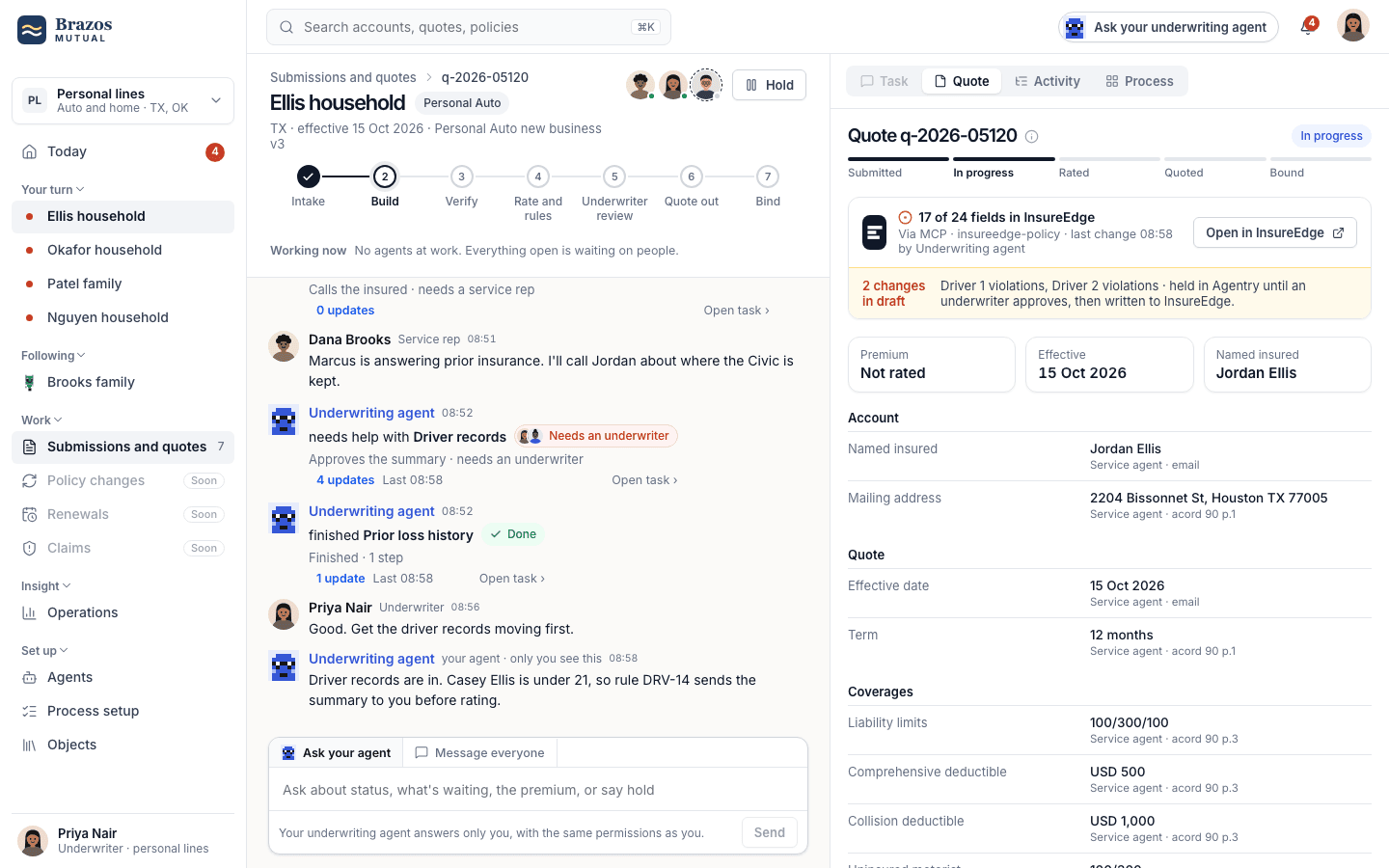
AI can do insurance work, but your operation has nowhere to put it
Agents can already read a submission or summarize a loss run. What's missing is the place they work: beside the right people, on the real record, inside the rules.
Agents have nowhere to work
The pilot answers questions in a chat tab. Nobody else can see what it did, the underwriter re-keys its answer into the core, and the audit trail is a screenshot.
Automation can't hold judgment
Workflow tools move data between steps. Insurance work refers, waits for authority, asks the right person and has to explain itself to a regulator later.
Cores were never built for agents
The record lives in the core, behind screens made for people. Agents either get no access, or broad API keys nobody can govern tool by tool.
An agent needs three things before it touches your core
The same problem, seen from the platform side. Agents need an identity, one source of truth and a policy layer that answers to your security team.
Every agent gets an identity
Agents sign in as themselves, with an owner, roles from your directory and a list of what they may never do.
Agents work on one record, not a copy
Each object is mapped to the system that owns it. Writes go through its tools; its changes come back as events.
Every call carries a policy and an audit entry
Every tool carries a policy. Every call, rule result and approval is written to an append-only log you export.
The same claim, before and after your agents join the room
Drag the handle to compare. Before, the claim is copied between tools and emailed as files. After, people and agents work on it together, and the core stays in step.
I opened the claim from the call. Two photos are still missing.
@Adjusting agent is rental covered?
Yes, 30 days. I drafted the reserve change for you.
Agents get a workbench, not another chatbot or workflow builder
You define the agents on top. Your core stays underneath. Everything in between, the conversation, the process, the rules, the approvals and the audit, is Workbench.
It runs in your perimeter, with your models, on your core
Workbench is software you deploy, not a service your data visits. It runs beside your policy, billing and claims systems, reaches them over MCP and open APIs, uses the models you already pay for and answers to your identity provider.
Workflow tools move data, and Workbench holds the work
They solve different problems and often sit side by side. The difference shows the moment a step needs judgment, authority or a regulator's question answered.
How Workbench connects to what you run
Open protocols, chosen per system. MCP where it exists, APIs where it doesn't, events for anything that changes outside Workbench. If you're on n8n, your flows become tools.
What's new is how agents work and what they work on
Two things are new: how people and agents share work, and the insurance objects they work on.
Agents are co-workers, not a chat box
Every agent has a name, a face, a role and permissions. Each person talks to their own agent, and everyone sees the work move. It feels like a shared office, not a queue.
Every decision leaves a trace
Rules steps record which ruleset ran, its version, owner, inputs and result. Business owners improve rules from the traces.
Changes wait as drafts until someone with authority approves
Agents prepare changes to the record. Anything that needs approval waits as a draft, then writes through the core's own tools.
Quotes, policies, and claims are native objects
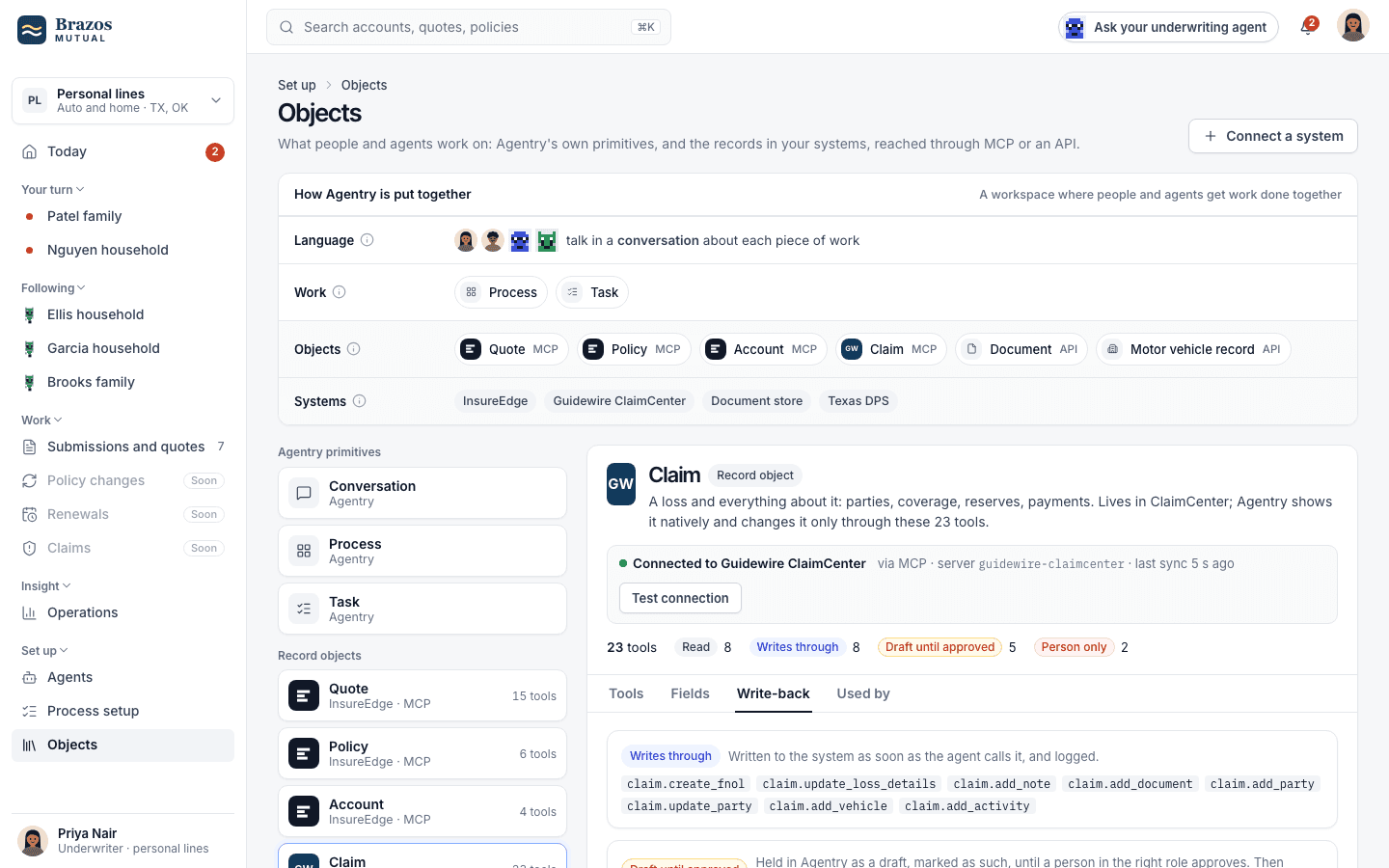
Workbench knows insurance objects and their states. Each one is mapped to your system of record and kept in step both ways: agents change it only through its tools, and changes made in the core arrive as events. Nobody re-keys anything.
Authority and referrals follow the role
Tasks lock to the role that holds authority. The people in that role are named, not a queue.
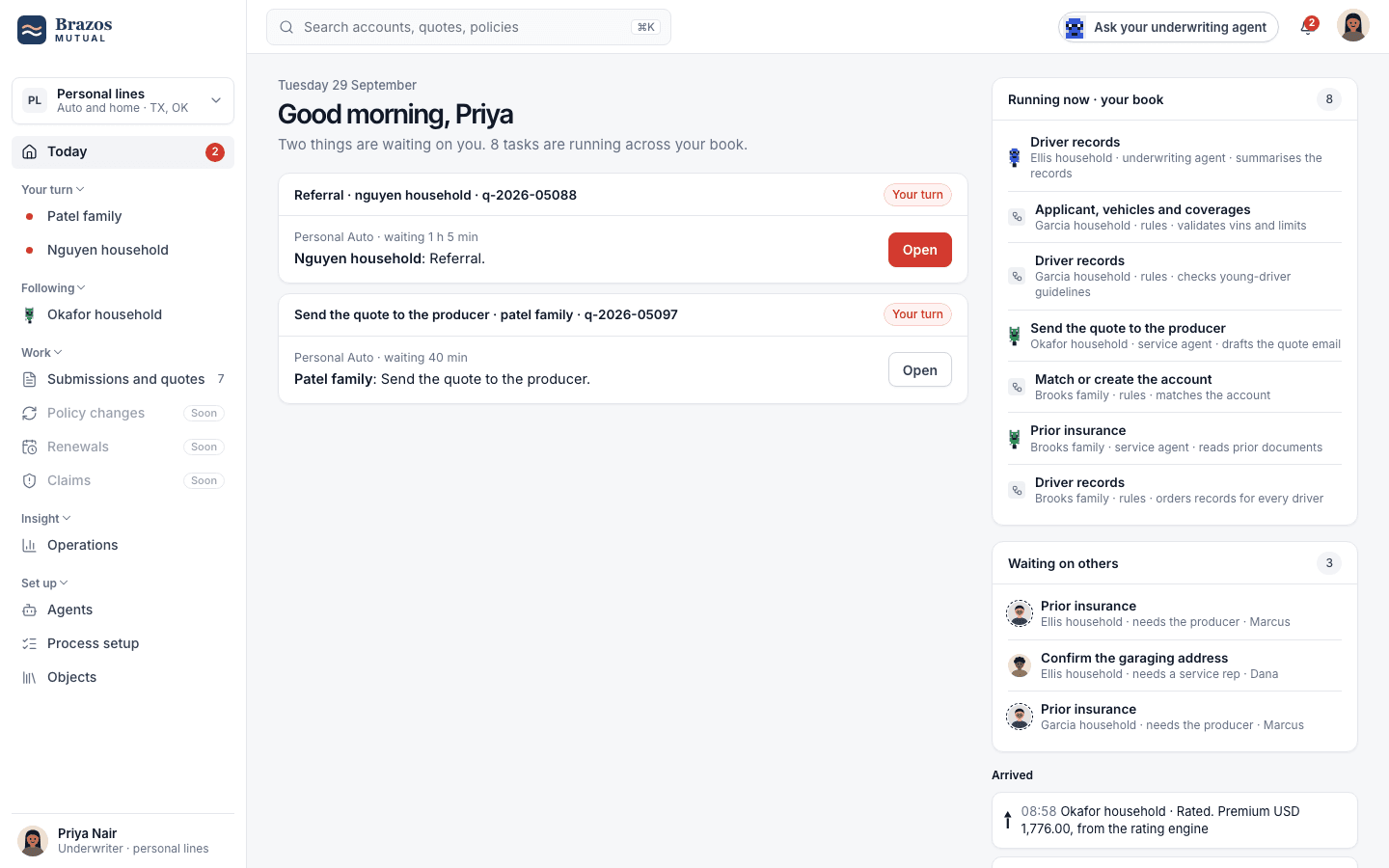
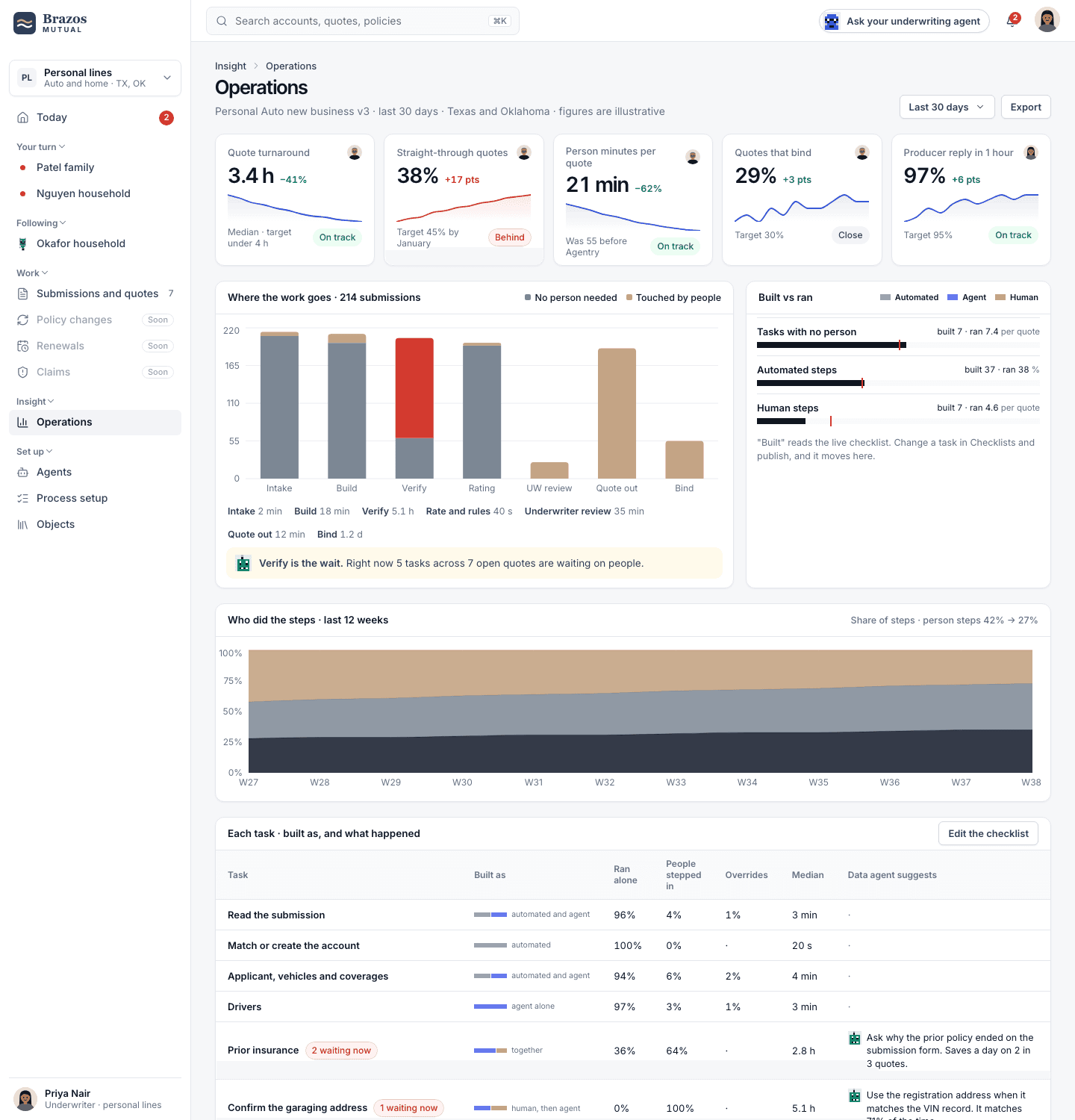
This is what your team will work in every day
Captured from the working prototype.
One record stays in step both ways
Workbench never copies your core into a second database of truth. It writes only through the core's tools and listens for the changes people make there.
We shape the base platform to your business and its constraints
Workbench ships with a process library. What makes your operation yours is configuration, and Damco shapes it with you.