
Generative AI Use Cases Across Industries: The 2026 Executive Playbook
Key Takeaways
- Adoption is solved; value capture isn’t. Only 5%[1] of companies are “future-built” and capturing outsized AI returns.
- Nine enterprise functions already show measurable ROI, led by content and marketing, healthcare, and banking.[1]
- Productivity gains are common (66%); revenue gains are still rare (20%).[2]
- The real risks are governance risks, including hallucination, data privacy, IP ownership, and model drift.
- Future-built firms redesign workflows around AI and post 1.7x revenue growth and 3.6x[1] shareholder returns versus laggards.
- Agentic AI is next: 62%[3] of organizations are already experimenting with autonomous, multi-step AI agents.
- First Move: pick one governed, high-volume process, assign an owner, and prove the unit economics before scaling.
Generative AI is no longer an emerging technology initiative. For most enterprises, the question is no longer whether to adopt AI, but how to convert adoption into measurable business outcomes. Despite widespread investment, the gap between experimentation and enterprise-wide value remains significant.
Research shows that only a small minority of organizations have successfully embedded AI into core operations and are capturing disproportionate gains in growth, profitability, and shareholder value.
For the leaders, the challenge is increasingly strategic rather than technical. Leaders must determine where generative AI can create sustainable competitive advantages, which business processes warrant investment, how governance should evolve, and what metrics define success. At the same time, they must balance the promise of productivity gains with concerns around data privacy, regulatory compliance, intellectual property, and model reliability.

The organizations pulling ahead are not deploying AI as a standalone tool. They are redesigning workflows, operating models, and decision-making processes around it. This executive playbook examines where generative AI is already generating measurable returns across industries, the financial realities behind the hype, the governance requirements for scaling responsibly, and how the rise of agentic AI is reshaping the next phase of enterprise transformation.
What Is Generative AI, and How Does It Differ from Predictive AI Models?
Generative AI is artificial intelligence that creates new text, images, code, audio, or synthetic data from a prompt, rather than only classifying or predicting from existing data. This distinction separates it from prior waves of enterprise AI and machine learning.
Built on top of foundation models, Generative AI can produce original content such as imagery, audio, video, computer code, text, simulations, synthetic data, and 3D renderings in response to text prompts. In other words, this disruptive technology can be used to generate various types of creative content based on the large volumes of unstructured or unlabeled data it is trained on.
- Traditional, predictive AI, including most machine learning and computer vision systems, recognizes patterns and forecasts outcomes, such as flagging a fraudulent transaction, but doesn’t create anything new.
- Generative AI goes further: Large Language Models (LLMs) generate human-like text and code, diffusion models generate images and video, and newer multimodal AI systems combine several of these in a single workflow.
In practice, this looks like a claims adjuster using Gen AI to draft a first-pass summary of a claim file, or a developer using it to scaffold a new feature; the model handles the first draft, and a person handles the judgment call.
The underlying capability stack, which includes natural language processing (NLP), computer vision, and increasingly multimodal AI, is converging into a single interface. This is why the use cases below cut across so many functions at once.
What Are the Top Use Cases for Generative AI?
Generative AI has moved beyond experiments to practical uses. Given below are the real-life applications that reveal how this technology helps people complete tasks faster, generate new ideas, and find better solutions to common challenges.
1. Healthcare & Lifesciences
Generative Artificial Intelligence in healthcare has emerged as a game-changer since it offers innovative solutions that augment research, diagnostics, and treatment of longstanding health issues. This technology also has the immense potential to transform drug discovery, treatment planning, and personalized healthcare solutions.
a) Medical Imaging: Gen AI is making strong strides in medical imaging by generating high-quality, synthetic images for X-rays, CT scans, and MRIs. This is beneficial for training ML models for tasks like organ segmentation, tumor detection, etc.
b) Drug Discovery: The drug discovery process is not only time-intensive but also expensive. Generative AI helps in drug discovery by generating molecular structures for new drugs. It can also analyze existing chemical and biological data and propose novel molecules with therapeutic potential. This accelerates drug discovery timelines and reduces costs.
“Generative AI is revolutionizing drug discovery by simulating molecular structures at unprecedented speed.”
– Daphne Koller, Founder & CEO, insitro
c) Virtual Health Assistants: Gen AI-based chatbots and virtual health assistants leverage NLP capabilities to understand and respond to patients’ inquiries, schedule appointments, provide medication reminders, and offer health-related information. By simulating human-like conversation, these intelligent assistants not only enhance patient engagement but also contribute to easy accessibility to healthcare resources, resulting in improved healthcare outcomes.
2. Retail & Ecommerce
Gen AI is making substantial inroads into the retail and ecommerce sector, offering a plethora of innovative solutions that not only revolutionize various aspects of the industry but also enhance the overall customer experience. Listed below are some popular use cases:
a) Visual Merchandising: Generative Artificial Intelligence can produce visually appealing and realistic product images that attract customers and increase conversions. It can generate high-quality, synthetic product images, combining features from different backgrounds, lighting conditions, and angles without the need for extensive photoshoots, which in turn contributes to an enhanced user experience. These synthetic images not only offer a cost-effective alternative but also allow retailers to respond promptly to changing trends.
b) Dynamic Pricing: Generative AI tools can process real-time data on customer behavior, competitor pricing, market conditions, and other relevant factors to dynamically adjust product prices. This adaptive pricing model not only maximizes profitability but also ensures responsiveness to changing market dynamics.
c) Personalized Marketing: Gen AI-based tools can analyze a large volume of datasets comprising purchase history, customer behavior, and preferences to create highly targeted and personalized marketing content, including targeted email campaigns, product recommendations, and personalized advertisements. In other words, this technology allows businesses to deliver content that resonates on a personal level, resulting in enhanced customer engagement.
3. Insurance
Gen AI is reshaping the insurance industry by introducing innovative solutions that streamline operations, automate claims processing workflows, enhance risk assessment, and elevate customer engagement. Below is a detailed exploration:
a) Fraud Detection and Prevention: The new-gen technology plays a critical role in mitigating fraudulent activities within the insurance sector. By leveraging data analytics and advanced machine learning algorithms, Generative AI can analyze large datasets that include customer behaviors, historical claims, and external risk factors to identify patterns indicative of potentially fraudulent activities. This disruptive technology continuously learns from historical data to detect anomalies and irregularities such as inconsistent information, unusual claim patterns, or suspicious activities.
b) Automated Claims Processing: Gen AI-based tools can help automate the entire claims workflow by extracting and analyzing relevant information from various documents, including forms, images, and textual data. By leveraging advanced ML algorithms, Gen AI-based tools can extract pertinent details, assess claim validity, and expedite the decision-making process. This streamlines the claims settlement process and reduces the likelihood of human errors.
c) Operational Efficiency and Cost Reduction: Gen AI tools can optimize various insurance processes, including risk assessment, claim processing, and underwriting. This empowers insurers to streamline workflows, allocate resources more strategically, and focus on value-added services, which in turn leads to enhanced operational efficiencies and cost reductions.
4. Manufacturing
Manufacturing companies are using smart Gen AI programs to make their work better and faster. These programs can think and learn like humans, but much faster. They help factories make better products, fix machines before they break, check quality, and manage supplies. This technology is changing how things are made and helping companies save money while making customers happier.
a) Product Design Optimization
Gen AI helps companies create better product designs by analyzing lots of information about what customers want and how products should work. These programs can suggest new shapes, materials, and features that make products robust, reasonable, and useful. They can also test thousands of different design ideas quickly without actually making the products first. This helps companies make things that people really want to buy.
b) Predictive Maintenance
Gen AI-based tools can monitor machines in factories and inform workers when something might break before it happens. They look at sounds, temperatures, and other signs that show when a machine is getting tired or worn out. This helps companies fix problems early instead of waiting for machines to stop working completely. Workers can also plan repairs during quiet times, so production does not stop suddenly.
c) Quality Control
Gen AI helps factories check if products are made correctly by looking at them carefully and quickly. These smart programs can spot problems that human eyes might miss and can check thousands of products in minutes. They compare each product to perfect examples and immediately inform workers if something is wrong. This means fewer bad products reach customers, and companies can fix problems right away.
5. Marketing
Marketers have started using gen AI to connect with customers in better ways. This technology helps them create interesting content, understand what different customers want, manage their social media accounts, and test which ideas work best.
a) Content Creation
Creating fresh content for websites, ads, and social media takes a lot of time and effort. Gen AI helps marketers write blog posts, product descriptions, and advertising messages much faster than before. This technology can create different versions of the same message to appeal to various groups of people. Marketers can now focus on bigger ideas while AI handles the writing tasks that used to take hours every day.
b) Audience Segmentation and Personalization
Every customer is different and wants different things from brands. Gen AI helps companies figure out what each customer likes by looking at their shopping habits and interests. This information helps companies send the right messages to the right people at the right time. Customers get offers and content that actually resonates with them, making them more likely to buy something and stay loyal to the brand.
c) Social Media Management
Managing social media accounts across different platforms can be overwhelming for businesses. Gen AI helps companies schedule posts, respond to customer comments, and keep track of what people are saying about their brand. It can also suggest the best times to post and what type of content will get the most attention. This helps businesses stay active on social media without spending all day managing their accounts.
d) A/B Testing
Companies often want to know which version of an ad or website works better with customers. Gen AI makes testing different versions much easier and faster than doing it manually. It can run multiple tests at the same time and quickly tell businesses which approach gets better results. This helps companies make smart decisions about their marketing based on real data instead of just guessing what might work.
6. Supply Chain & Logistics
Supply chain and logistics companies have begun using gen AI tools to make their operations run more efficiently. This technology helps them predict what customers will need, plan better routes for deliveries, and manage their warehouse stock more effectively. Businesses are discovering that Gen AI reduces costs and helps them deliver products faster while keeping customers satisfied with reliable service.
a) Demand Forecasting
Knowing how much of each product customers will want in the future is one of the biggest challenges for any business. Gen AI helps companies look at past sales data, seasonal patterns, and current market trends to predict future demand more accurately. It considers many different factors that affect buying behavior and gives businesses a clearer picture of what to expect. This helps companies produce the right number of products without running out or having too much leftover stock.
b) Supply Chain Planning
Planning how products move from factories to customers involves many complicated decisions about routes, timing, and resources. Gen AI helps companies figure out the best ways to organize their supply chains by analyzing traffic patterns, weather conditions, and delivery costs. It can quickly adjust plans when unexpected problems happen, like road closures or supplier delays. This helps businesses keep their promises to customers even when things don’t go as originally planned.
c) Inventory Optimization
Keeping the right number of products in warehouses is a delicate balance that affects both costs and customer satisfaction. Gen AI helps companies decide exactly how much inventory to keep on hand by studying sales patterns and delivery times. This technology considers factors like storage costs, product shelf life, and seasonal demand changes to make smart recommendations. This prevents businesses from wasting money on storing too much while ensuring they never run out of popular items that customers want.
Having explored the use cases, the next question that comes to mind is: what is the ROI? Most enterprises report productivity gains, not yet revenue gains: Deloitte[2] found two-thirds (66%) of organizations see productivity or efficiency benefits from AI, but only 20% report AI-driven revenue growth. The financial upside is real, but concentrated. Here’s a closer look:
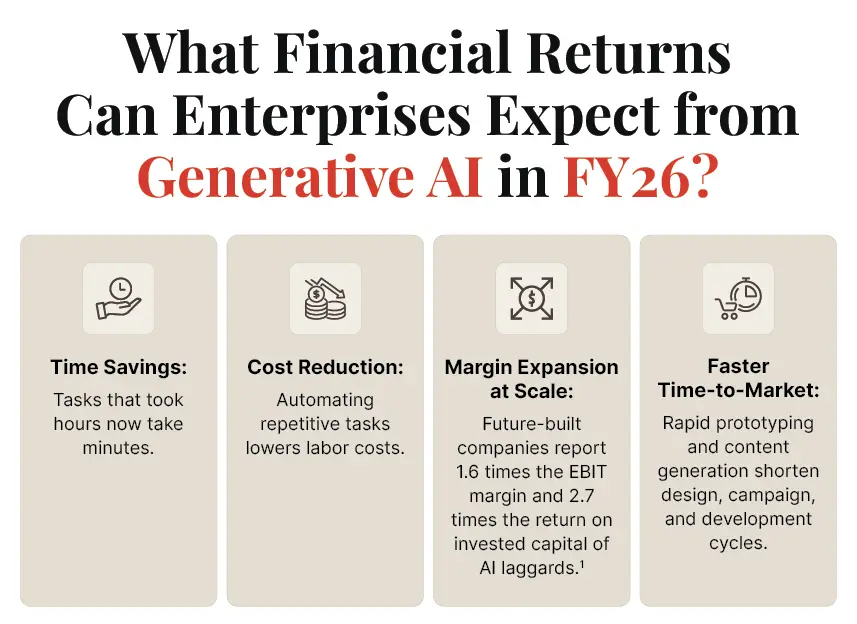
The organizations seeing the strongest returns share one habit: they redesign the workflow around generative AI as part of a broader digital transformation, instead of bolting a chatbot onto an existing process; a pattern BCG’s[1] research also confirms among its top performers. In fact, a case study shows that a leading asset management firm delivered elevated user experience with a Gen AI chatbot.
Returns like these rarely come risk-free, and the risks are precisely where most generative AI initiatives stall out before they ever reach scale.
How Does Generative AI Implementation Mitigate or Create Risk in FY26?
Generative AI reduces manual-error risk in high-volume processes, but introduces new governance risk of its own. This includes hallucination, data privacy exposure, unclear IP ownership, and model drift at the top of the list of enterprise concerns.
- Hallucination: Models can produce plausible-sounding but incorrect output, so high-stakes use need human review before content is acted on.
- Data Privacy: Feeding proprietary or customer data into generative models raises questions about where that data goes.
- IP Ownership: Who owns AI-generated content, and whether it infringes on copyrighted material, remains a legal gray area.
- Model Drift: Performance can degrade as real-world data shifts away from what the model was trained on.
- Human-in-the-Loop Validation: The organizations getting the most value treat generative AI as a co-pilot, not an autopilot.
A responsible AI framework, i.e, clear AI governance policies on data use, model evaluation, and human oversight, is what separates organizations that scale generative AI safely from the 60% BCG[1] found stuck without measurable value. None of this is a reason to avoid generative AI; it’s a reason to pair every rollout with the right guardrails from day one.
Naming the risks is the easy part. Building them into a disciplined decision process before capital moves is where most leadership teams fall short.
What Should the Leaders Ask Before Investing in Gen AI?
Adoption is no longer the differentiator, as nearly nine in ten organizations already use gen AI regularly.[3] The differentiator is whether leadership asks four questions before scaling a pilot into a budget line. Here are these:
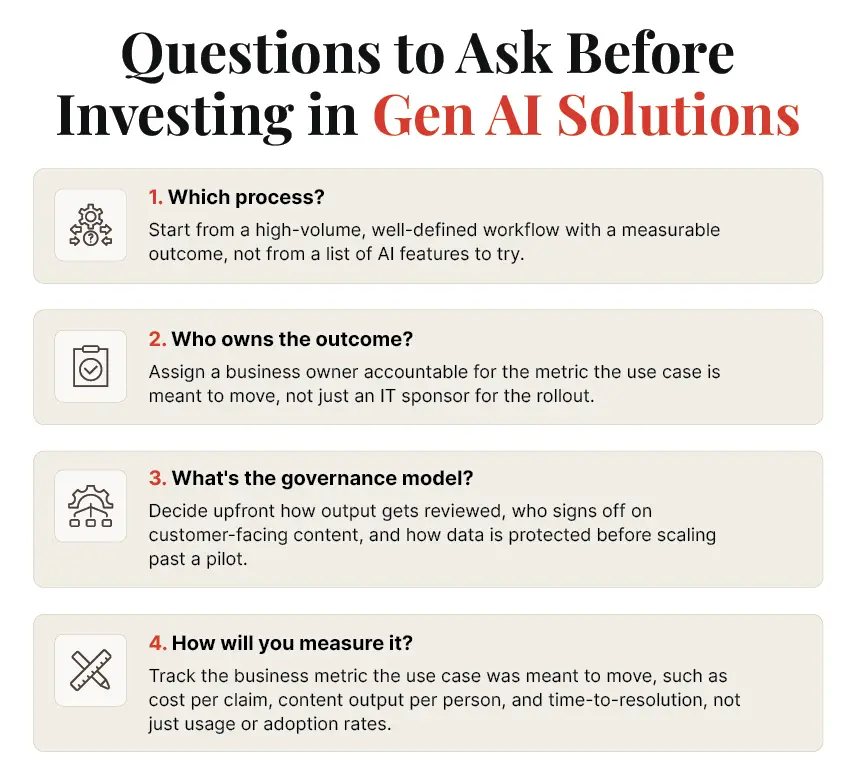
Leaders who answer these four questions before scaling a pilot tend to close the adoption-to-impact gap faster than leaders who simply add more use cases to an ungoverned rollout: the pattern BCG[1] links to future-built outperformance.
Answer those four questions well, and the natural next move isn’t another generative AI pilot; it’s the shift already underway toward autonomous, agentic execution.
Is Agentic AI the Next Balance-Sheet Priority for the Enterprise?
Yes, agentic AI already accounts for 17% of total enterprise AI value and is projected to nearly double by 2028[1], while 62% of organizations are already experimenting with AI agents.[3]
Where a generative AI tool today might draft an email or summarize a document on request, an agentic AI workflow can pull data from a CRM, draft the email, send it, and flag exceptions for review, without a person prompting each step.
In insurance, that might mean an agent that not only drafts a claim summary but also checks policy terms, flags a coverage gap, and routes the file to the right adjuster; the kind of multi-step handoff that used to require several people and several systems.
For enterprises, the generative AI use cases outlined above are a starting point, not an end state. The data foundations and governance built for generative AI today are what agentic AI will run tomorrow.
None of this, the use cases, the returns, the governance model, and the agentic roadmap, has to be built alone, or from a standing start.
How Does Damco Help Convert Gen AI Into Measurable Business Impact?
A specialist partner shortens the distance between a generative AI pilot and a measurable P&L result by bringing pre-built governance, industry-specific use cases, and digital transformation and integration expertise that would otherwise take an internal team quarters to build from scratch.
The transformative power of generative AI is nothing short of revolutionary. As we navigate through the intricate landscapes of businesses across industries, it becomes evident that embracing this disruptive technology is a strategic imperative to drive innovation, efficiency, and productivity.
If you are also planning to harness the power of this emerging technology, it’s wise to seek Generative AI consultation from a reliable partner.
External Links
Tell us what you're working on
A strategist reads every reply and writes back.