
Policy Administration Systems for Insurers: What’s Changing in 2027 and What Still Breaks After Go-Live
Key Takeaways:
- Modernization is no longer just about migrating platforms, it’s about who continuously engineers them after go-live.
- Legacy, cloud-based, and AI-enabled policy administration systems each solve different problems. Most carriers run a combination of all three, modernizing module by module rather than in a single cutover.2027’s defining shift: agentic AI, real-time data, and AI governance move from pilot projects to standard operating requirements.
- Core modernization projects still underdeliver after go-live when ownership of the engineering work lapses the moment vendors and implementation partners step away.
Legacy policy administration systems for insurers, once cost-savers, now drain billions and erode competitiveness. The case for replacing them is well established: a modern core platform with digital capabilities can improve efficiency and customer experience, lift revenue by up to 25%, and compress product launch cycles three to fourfold. The foundation is strong. Yet operational benefits remain inconsistent across carriers who’ve completed migrations successfully. The problem isn’t the platform; it’s what happens after go-live.
Heading into 2027, that problem is compounding. According to industry research, 70%[1] of core modernization projects fail despite modern technology. The pattern reveals an engineering gap, which vendors don’t fill. Carriers invest in the right policy admin system for insurers, execute migration and go live successfully, and then discover the platform only delivers value through ongoing engineering that adapts to quarterly regulatory changes, weekly product launches, market shifts, evolving distribution channels, and AI governance needs. This continuous engineering gap opens exactly where vendor support ends, and migration consultants depart.

For CXOs, the practical question in 2027 isn’t “which platform should we buy?” That’s because most shortlisted platforms are architecturally comparable. The question is who owns the ongoing engineering work after the contract is signed and the implementation partner moves on to the next account. That answer determines whether the modernization budget shows up as a one-time capital project or as a compounding operational advantage.
How Have Policy Administration Systems for Insurers Evolved?
Policy administration systems for insurers have moved through three broad generations: legacy mainframe systems built for stability rather than speed, cloud-based platforms built for configurability and connectivity, and AI-enabled systems built for continuous adaptation.
The shift has never been a clean handoff from one generation to the next. Most carriers today run some combination of all three, modernizing module by module rather than in a single cutover. What has changed heading into 2027 is the layer sitting on top of that architecture. AI-enabled systems don’t treat automation as a bolt-on added after deployment; they treat it as a governed, continuously monitored capability built into how the platform operates day to day, from underwriting assistance to claims triage to customer self-service. For a fuller treatment of platform capabilities and where their limits sit, see our guide to choosing an insurance policy management system.
Legacy vs. Cloud-Based vs. AI-Enabled Policy Administration Systems
| Capability | Legacy PAS | Cloud-Based PAS | AI-Enabled PAS |
|---|---|---|---|
| Architecture | Monolithic, mainframe-based | API-first, microservices | AI-first and event-driven, real-time |
| Deployment | On-premises | Multi-tenant SaaS | Multi-tenant SaaS, continuous releases |
| Product Launch Ceiling | 12-18+ months | Weeks to months | Days to weeks with templated configuration |
| AI Capability | None; deterministic RPA at best | Embedded GenAI features | Embedded agentic AI with governance hooks |
| Integration Model | Point-to point, custom interfaces | API-first ecosystem connectivity | API-first with agent-coordinated workflows |
| Regulatory Adaptation | Manual, project-based | Pre-built compliance frameworks | Pre-built frameworks plus continuous rule deployment |
| Customer Experience | Agent- and call-center | Digital portals, self-service | Real-time, omnichannel, personalized |
| Governance Tooling | Minimal; largely undocumented | Configuration controls, sprawl unmanaged | Explainability, bias monitoring, audit trails |
Most 2027 modernization conversations aren’t “legacy versus cloud” anymore. They’re about how far into the third column a carrier’s operating model can actually reach. A carrier can license a fully AI-enabled platform and still run it like a legacy system if it lacks the engineering capacity to use what that platform makes available. This is why platform selection and operating model are increasingly treated as one decision, not two.
Which Policy Administration Trends Are Raising the Engineering Bar in 2027?
Four shifts are reshaping policy administration heading into 2027. What they share is easy to miss: each one expands what the platform can do, and each one expands what the carrier has to engineer in order to use it safely. The capability and the obligation arrive together.
Agentic AI Moves from Pilot to Operating Layer
Insurers are deploying AI agents that coordinate multi-step workflows across policy administration, billing, and claims, including assembling document packages, triaging submissions, applying policy rules, routing exceptions to human underwriters. The distinction that matters is that an agent pursues a goal across several steps rather than waiting to be directed at each one. The carriers furthest along treat agentic AI as an orchestration layer over existing systems, not as a reason to replace the platform underneath it.
Real-Time Data Replaces Batch Processing
Event-driven architecture is displacing the nightly-batch model that still quietly underlies many platforms marketed as modern. Carriers are prioritizing systems that push policy, billing and claims data across the ecosystem the moment something changes. The gap stays invisible until it isn’t: a self-service portal looks identical whether the backend is real-time or batch, right up to the moment a policyholder acts on data that hasn’t caught up.
AI Governance Becomes a Procurement Requirement
As the NAIC Model Bulletin on the use of AI is adopted across more states and EU AI Act obligations phase in for high-risk applications including underwriting and pricing, explainability, bias monitoring and audit trails are being specified as baseline capability rather than roadmap items requested alongside product demos rather than after shortlisting. The platforms winning RFPs in 2027 answer governance questions in the same breath as feature questions.
Embedded and Parametric Products Stress the Product Engine
Distribution through partners, marketplaces and point-of-sale channels demands quote-and-bind APIs that respond in milliseconds and partner onboarding measured in weeks. Parametric covers add automated, trigger-based settlement to a product engine originally designed for underwritten indemnity. Both push configuration workloads well past what an annual release cadence can absorb.
| 2027 shift | What the platform gives you | What you still have to engineer |
|---|---|---|
| Agentic AI | Embedded agents, prebuilt workflow templates | Model governance, explainability at every step, human checkpoints, NAIC and EU AI Act adaptation |
| Real-time, event-driven data | Event bus, streaming APIs | Event schema versioning, replay and failure handling, continuous integration health across 20–40+ connections |
| AI governance as procurement baseline | Audit logging, bias-detection tooling | Evidence generation, retraining triggers, divergence between NAIC and EU regimes |
| Embedded and parametric products | Configurable product engine, partner APIs | Templated product structures, pre-tested rating, automated compliance gates, partner onboarding at scale |
The pattern is consistent. Every shift in the left-hand column arrives as a platform capability and lands as an engineering obligation. Platforms are becoming AI-native by default; the discipline to operate them is what separates carriers in 2027. Which raises the question of exactly where the platform’s responsibility ends.
“The actual trigger to act on legacy systems is not the inability to address the market or drive change. It’s the fact that legacy systems are becoming obsolete, and this creates technological and regulatory risk.”
– Aleš Zajc, Business Development & Client Success Manager, Adacta
As real-time, event-driven architecture becomes the 2027 default, integration health stops being a periodic check and becomes a continuous monitoring requirement. A broken connection surfaces in minutes, not at the next reconciliation cycle.
| Capability | Legacy PAS | Cloud-Based PAS | Modern AI-Enabled PAS |
|---|---|---|---|
| Architecture | Monolithic, mainframe-based | API-first, microservices | API-first + event-driven, real-time |
| Deployment | On-premise | Multi-tenant SaaS | Multi-tenant SaaS, continuous releases |
| Product Launch Speed | 12-18+ months | Weeks to a few months | Days to weeks, templated configuration |
| AI Capability | None, or bolted-on RPA | Embedded GenAI features | Embedded agentic AI with governance |
| Integration Model | Point-to-point, custom interfaces | API-first ecosystem connectivity | API-first + agent-coordinated workflows |
| Regulatory Adaptation | Manual, project-based | Pre-built compliance frameworks | Continuous, engineered as input stream |
| Customer Experience | Agent-mediated only | Digital portals, self-service | Real-time, omnichannel, personalized |
| Governance Maturity | Minimal, undocumented | Configuration sprawl risk | Explainability, bias monitoring, audit trails |
Most 2027 insurance PAS conversations aren’t “legacy vs. cloud” anymore. They’re about how far into the third column an insurance carrier’s operating model can actually reach. An insurance carrier can license a fully AI-enabled platform and still operate it like a legacy system if it lacks the engineering capacity to use the third column’s capabilities. This is why platform selection and operating model are increasingly treated as one decision, not two.
What Does “Continuous Engineering” Mean for Insurance Policy Administration?
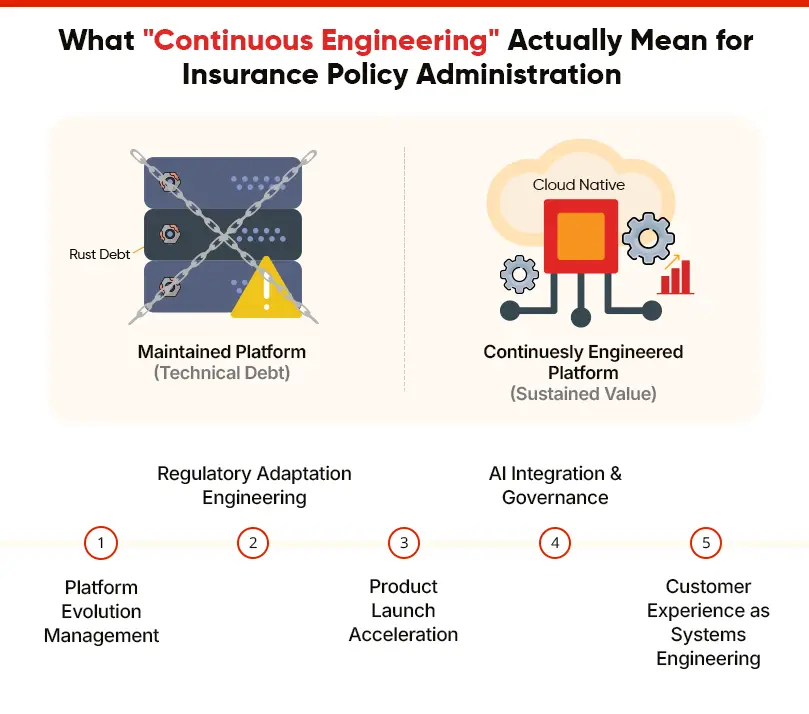
Insurance carriers migrating to an AI-enabled or a cloud-based policy administration system expect better performance, faster product launches, and lower costs. What many get instead is a modern platform operated like a legacy system that is deployed once, updated rarely, and allowed to gradually accumulate technical debt until the system becomes as rigid as the mainframe it replaced.
The difference between carriers extracting sustained platform value and those accumulating cloud-native technical debt comes down to one distinction: whether the policy administration system is continuously engineered or merely maintained. Here are the five dimensions that define this operating model.
1. Platform Evolution Management
Most cloud-native insurance platforms ship updates quarterly or more frequently. Each release includes new features, security patches, performance improvements, and API changes. Continuous engineering means evaluating every release for relevance, testing it against existing configuration, and deploying selectively without destabilizing operations. The carriers furthest along track version currency as a standing metric in quarterly technology reviews, alongside uptime and processing SLAs because the alternative is a platform that drifts quietly out of support.
2. Regulatory Adaptation Engineering
Regulatory change in insurance is relentless, not occasional. With hundreds of jurisdictional changes annually, policy administration systems must absorb new rates, rules, filings, and workflows without triggering regression across products or states.
Continuously engineered policy administration systems treat regulation as an input stream, not a disruption. Changes are engineered, tested, and deployed as part of an ongoing cadence, preserving system stability while maintaining compliance. This separates regulatory agility from operational fragility.
3. Product Launch Acceleration
Cloud-based policy administration systems promise faster product launches. The reality depends entirely on whether product configuration capability is continuously engineered. This means templated product structures, pre-tested rating engines, automated compliance checks, and deployment workflows ready to execute when the business brings a new product. Without it, configurability stays theoretical; buried under manual testing, ad hoc dependencies and brittle workflows.
4. AI Integration and Governance as Ongoing Discipline
AI integration in insurance is not a feature rollout; it is a permanent operating responsibility. Models must be retrained as data shifts, governance frameworks need updates as regulations evolve (EU AI Act), and performance should be monitored against business KPIs, bias detection, and explainability documentation.
Static AI deployments degrade quickly: a model trained on 2025 submissions will misprice against 2027 exposure patterns long before anyone notices.
Regulatory divergence compounds it NAIC-aligned governance is a starting point, not a sufficient answer to EU AI Act conformity assessment and post-market monitoring obligations. Continuous engineering keeps explainability, bias detection and audit readiness current alongside performance.
“As AI advances, the insurance company will continue modernizing its core platforms, keeping data AI-ready and carefully selecting use cases and partners for new capabilities.”
– Andrew Palmer, EVP and CIO, Global Retail Markets, Liberty Mutual
5. Customer Experience as Systems Engineering
CX gaps in insurance persist because they are rooted in systems latency, not interface design.
A portal can look modern and still respond slowly because backend systems batch-process requests; self-service can exist and still fail because cross-channel data synchronization is unreliable. Solving that requires real-time data pipelines, omnichannel orchestration and performance optimization – not a redesign.
Why Can’t Most Insurers Build Continuous Engineering Capability In-House?
The case for building continuous engineering capability internally seems straightforward. You own the system. You understand business. You should control its evolution. This logic works for traditional IT operations but breaks down completely for continuous engineering of modern insurance platforms.
Four structural constraints prevent most carriers from sustaining this model in-house. These are not temporary hiring challenges or budget cycles; they are permanent mismatches between what continuous engineering requires and what insurance IT organizations can realistically provide.
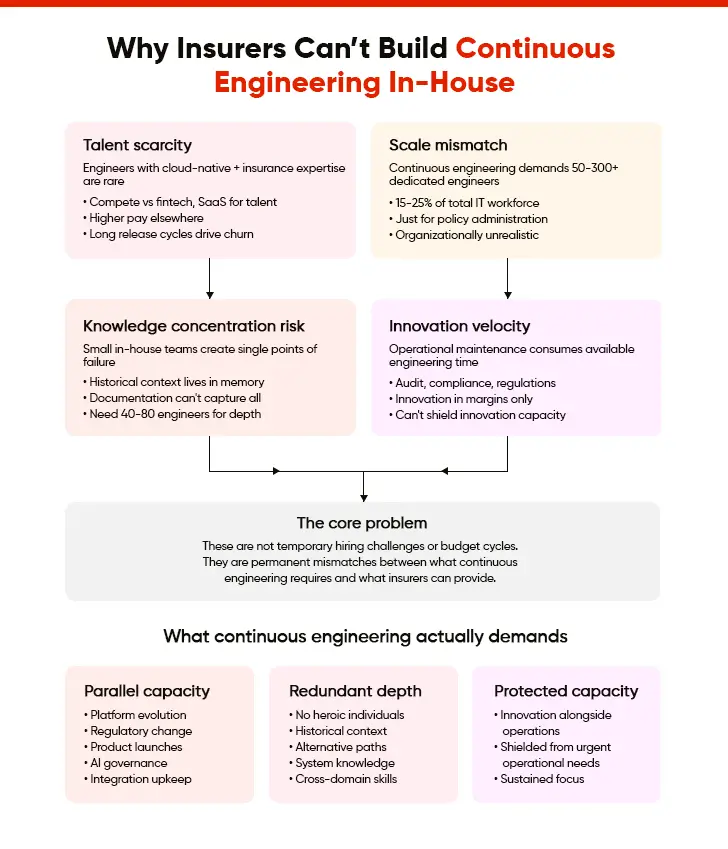
I. Talent Scarcity
Engineers who can operate modern cloud-native policy platforms while navigating actuarial logic, product configuration, and regulatory nuance are rare. The insurance market competes directly with fintech, healthtech, and SaaS firms that offer higher pay, faster cycles, and more visible technical impact.
Even when insurers hire such talent, retention is fragile. Long release cycles, heavy compliance overhead, and limited architectural autonomy make it difficult to keep engineers hooked. The result is churn exactly where continuity matters most.
II. Scale Mismatch
Continuous engineering is often perceived as “better DevOps.” In reality, it demands parallel capacity for platform evolution, regulatory change, product launches, AI governance, integration upkeep, and experience optimization. For mid-to-large carriers, this demands 50-300+ engineers dedicated solely to policy administration. This scale excludes claims, billing, and analytics systems.
Set against a technology function of 800–2,000 staff supporting every system the carrier runs, the implication is stark. A carrier with 1,200 technology staff standing up a 150-engineer policy administration capability is committing one in eight of its entire technology workforce to a single platform.
III. Knowledge Concentration Risk
Most carriers that do build in-house land at 10–20 engineers for the platform — enough to run it, not enough to de-risk it. When a senior engineer who understands the platform’s integration architecture leaves, the organization loses more than skills. It loses historical context. Documentation helps, but critical decision context, like why certain configurations exist, what alternatives were rejected, which workarounds address which limitations, lives in individual memory.
Continuous engineering requires redundant depth across domains, not heroic individuals. Building this redundancy internally means maintaining 40-80 engineers when you can justify budget for 15-20.
IV. Innovation Velocity
Internal IT teams spend the majority of their capacity on operational maintenance and regulatory compliance. Keeping systems running, meeting audit requirements, and implementing mandated regulatory changes consume available engineering time. Innovation survives only in the margins, competing for attention against issues that carry immediate risk.
Continuous engineering requires protected capacity for innovation alongside operations. Most insurers cannot shield that capacity internally without jeopardizing operational commitments.
These four constraints are not problems to solve; they are structural realities to acknowledge. The challenge is not purely technical. West Monroe’s 2026 research found that 94%[2] of surveyed health insurers had at least one strategic technology program delayed or cancelled for budget reasons in the preceding 12 months.
This figure is specifically for payer-specific health insurers. Think of the other insurance LOBs. That’s why most mid-to-large insurance carriers cannot build continuous engineering capability in-house at scale.
The alternative is not abandoning continuous engineering but accessing it through partnership models where specialized firms maintain the engineering scale, domain depth, and innovation capacity that individual carriers cannot sustain economically.
How Does Damco Engineer Insurance Operations, Not Just Policy Admin Systems?
Most insurers own their policy platforms, but only a few truly control their evolution. The constraints described above are real – but they are constraints on dedicated capacity, not on access to it. That distinction is what makes a partnership model work economically where an in-house build does not.
The reason is pooling. A NAIC model bulletin adoption, a vendor release absorbed into a configured implementation, an EU AI Act conformity pack – each is engineered once and adapted across carriers rather than rebuilt inside every IT function. The redundant depth a single carrier cannot justify for one platform is exactly what a specialist firm sustains as its core business.
Damco applies that model across the three areas carriers cannot resolve alone:
Parallel capacity. Platform evolution, regulatory adaptation, product configuration, AI governance and integration health run as concurrent workstreams rather than competing for the same scarce engineers.
Redundant depth. Insurance domain and platform engineering expertise is held across teams rather than concentrated in individuals, so a departure is a staffing event rather than a loss of institutional memory.
Protected innovation capacity. Engineering capacity for new capability is contracted and ring-fenced rather than surviving in the margins of operational firefighting.
The result is an operating capability that compounds: a policy administration estate that absorbs vendor releases, regulatory change and new AI capability on a standing cadence, instead of accumulating the debt that erodes the original business case.
Summing Up
The debate is no longer about whether cloud-based policy administration systems for insurers work. They do, since the architecture is sound, AI capabilities are production-ready, and migration paths are proven. But they’re just foundations. The debate that actually matters in 2027 is who keeps the platform evolving after go-live.
Value comes from building or partnering for continuous engineering capability that evolves the platform as rapidly as the insurance business changes. That’s the shift from static platforms to continuously engineered operations. And that shift determines whether your modernization investment pays off returns for one year or sustains competitive differentiation for a decade.
External Links:
- [1]: BCG Platinion
- [2]: West Monroe Insights
Read more from our blog
Tell us what you're working on
A strategist reads every reply and writes back.