
AI and NLP in Claims Processing: From Automated Documentation to a Redefined Claims Journey
Executive Summary:
- NLP structures documents in the back office, and conversational AI handles claimant contact in the front office. Fund one without the other and the bottleneck simply moves.
- AI speeds FNOL intake, recommends triage paths, prepares investigation-ready files, answers status questions, and assembles settlements.
- Humans own denials. AI recommends and, within pre-set limits, pays. A qualified person makes and signs every denial, reduction, or rescission.
- Start narrow, measure rigorously. Begin with high-volume, simple claims, baseline seven KPIs, and expand only when the evidence supports it.
AI in claims processing uses NLP and conversational AI to handle the work between first notice of loss and settlement. NLP reads and structures claim documents and correspondence. Conversational assistants take loss reports, answer status questions, and request missing information. Adjusters keep every judgment call, including denials, and spend their time investigating instead of keying data.
Filing an insurance claim is a big deal for many policyholders, and it rarely comes at a good time. A car is off the road, a roof is leaking, or someone is hurt. Heavy paperwork, dense policy language, and slow processes stress at exactly the moment a policyholder needs reassurance. But insurers don’t make claimants wait on purpose.
The delays come from the process itself. Manual data entry, non-standardized data formats, and compliance checks slow down claims processing. On top of that, adjusters carry heavy caseloads, leading to bottlenecks, potential errors, and high operational costs. For the carrier, the cost shows up in loss adjustment expense, leakage from rushed decisions, and retention.
Every interaction either reinforces the promise of security and care or weakens it. Conversational AI, working alongside NLP, turns claims from a slow, opaque process into a fast, transparent, and reassuring one.
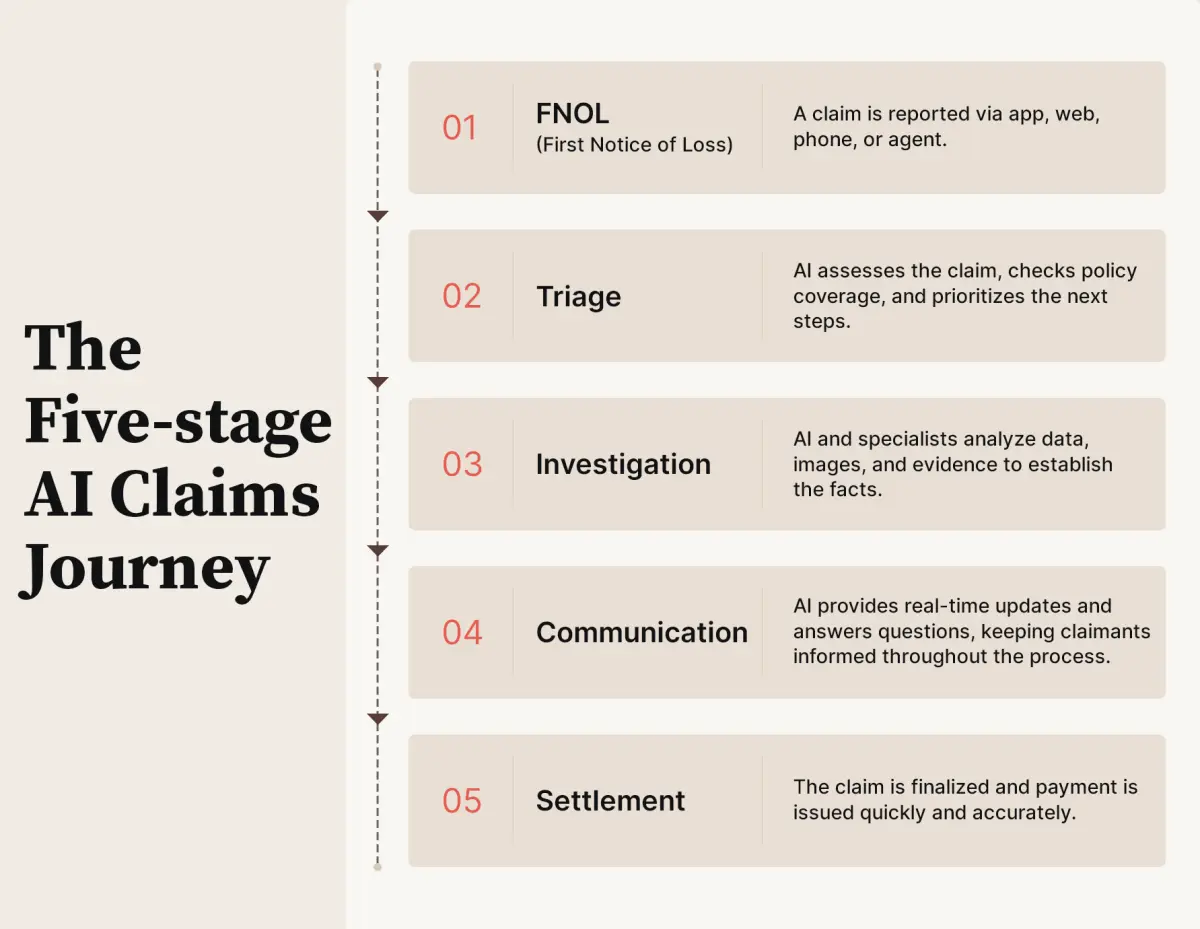
This guide takes you through the five stages of a claim, then covers how to integrate, govern, and measure AI across the AI claims journey. For the fundamentals, see our insurance claims management guide.

How Is AI Used in Claims Processing?
AI works on two connected layers in insurance claims processing. NLP extracts, validates, and routes information in the back office. Conversational AI collects it and keeps claimants informed in the front office. Both share one claim record, so improving only one layer moves the bottleneck elsewhere.
Consider a carrier that invests in only one layer. A polished chatbot on top of manual back-office handling promises speed it cannot deliver: a fast acknowledgment, then weeks of silence. Automated extraction behind a phone-only front end builds a clean file faster, but claimants still call to ask where things stand.
The J.D. Power 2026 U.S. Property Claims Satisfaction Study[1] shows why both layers matter. Homeowners still wait an average of 40.7 days for final payment. Meanwhile, 45% of customers use digital tools to receive claim updates, and satisfaction is higher among those who do.
On the auto side, the J.D. Power 2025 U.S. Auto Claims Satisfaction Study[2] put average repair cycle time at 19.3 days, down from 22.3 days a year earlier. The back office surely sets the clock but the front office decides how the wait feels.
The two layers are linked by natural language understanding: the ability to interpret what a claimant says and what a document contains. Because both depend on it, conversational AI in insurance claims should be planned, governed, and measured alongside back-office automation, as one program.
What Has Changed Since 2025?
Three shifts have redefined what AI can do in claims, and what it is allowed to do:
From Scripts to Language Models
The first generation of chatbot insurance claims tools followed fixed scripts, like a phone menu while back-office NLP ran as separate, template-bound tools. Today’s systems run on large language models (LLMs) that interpret ordinary language, read unfamiliar documents, and take limited actions.
From Automation to Bounded Agency
These systems now work as AI agents that act only within decision limits a human sets, with human sign-off on anything consequential.
From Guidance to Examination
Regulators now actively check how insurers use AI. As of October 2026, 29 jurisdictions[3] have adopted the NAIC’s AI Model Bulletin, and an NAIC evaluation tool for examiners is moving from pilot to adoption.
The rest of this blog follows a claim through five stages and shows where each shift applies. But before that, let’s take a quick look at the five stages of claims journey.
Capture Every Loss Faster at First Notice of Loss
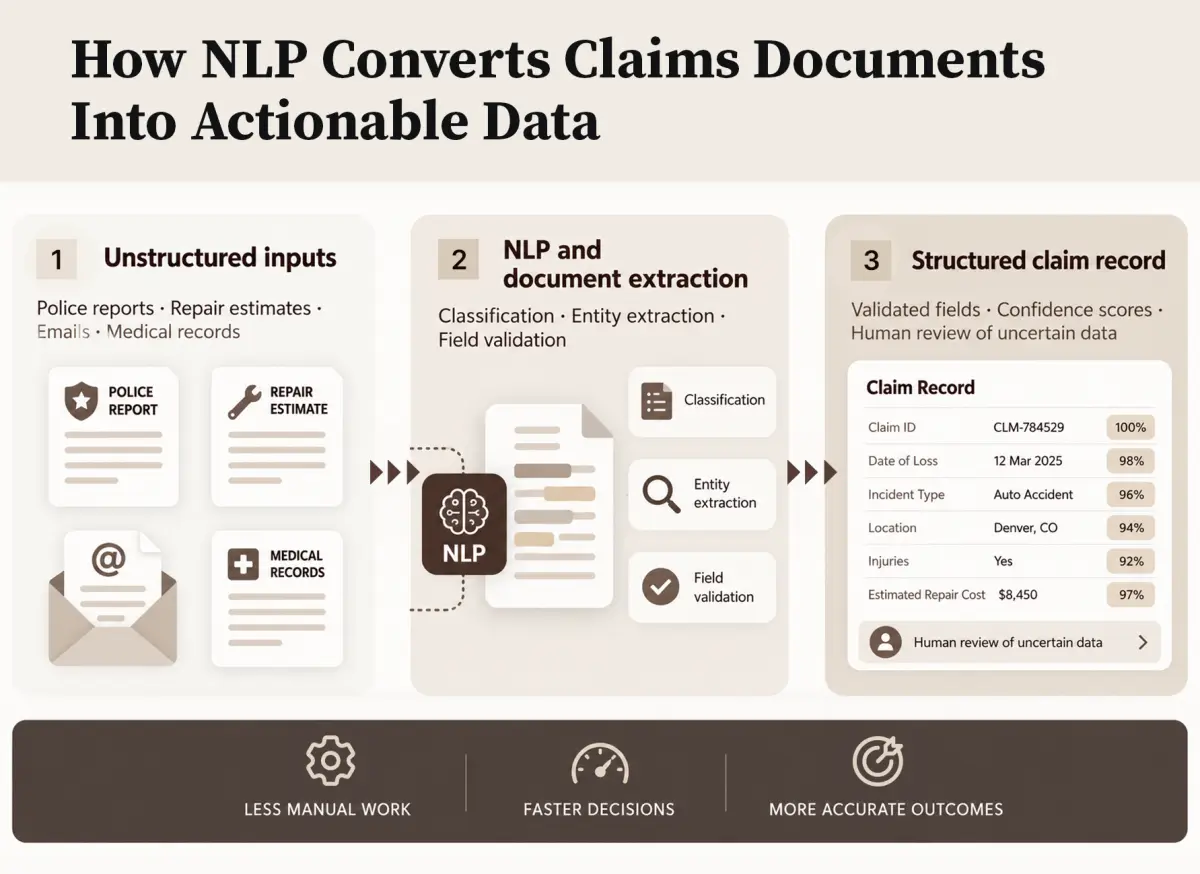
At first notice of loss (FNOL), AI lets claimants report by voice, chat, photo, or video at any hour. NLP turns what they submit into structured data and an automated check confirms it against the policy, so the adjuster receives a validated file on day one.
A customer usually files a claim by phone, email, or in person. Each channel captures different details in a different format, and every handoff to customer service, underwriting, or legal adds to processing time. FNOL automation closes that gap at the source.
Let Claimants Report by Voice, Chat, Photo, or Video with Conversational AI
Suppose James, on his office trip, stops at a diner en route. While parking his car, he nicks a nearby vehicle and breaks his own car’s side mirror. Instead of calling a helpline or filling out forms in person, James can open the insurance app, call the claims line, or message the virtual assistant. Each channel asks simple, guided questions:
- Is everyone safe, including anyone traveling with you?
- Can you upload pictures or videos of the damage?
- Do you have the other car’s license plate or the owner’s contact details?
- Can you also describe briefly how it occurred? You can type it or say it.
Safety comes first by design: if James reports an injury, the assistant hands him to a person immediately. For connected vehicles, telematics data can pre-fill the time, location, and force of impact.
Use NLP to Turn Intake Documents Into Structured Claim Data
In a traditional process, intake staff collected policy and claim details from the customer, then re-keyed them into the claims system. NLP-based document extraction replaces that step. It pulls key details out of police reports, repair estimates, invoices, and photos, and turns them into organized data.
“AI by itself is worthless unless you can surgically improve the way an adjuster or a claim manager or a car company can deal with their customers.”
– Githesh Ramamurthy, Chairman and CEO, CCC Information Services
Older OCR and template tools broke when a form layout changed. LLM-based extraction reads unfamiliar documents and gives each field a confidence score; low-confidence fields go to a person to confirm. This eliminates redundant questions and enables structured data for systems to process. That is NLP claims processing at intake and claims document automation in practice. For depth, see how intelligent document processing transforms claims handling.
Check Coverage Before the Adjuster Opens the File
Once details are structured, AI checks them against the policy administration system in seconds. Is the policy in force on the date of loss? Is the vehicle or property listed? Which deductible and limits apply? Gaps are flagged, not decided. The adjuster (the insurer’s employee who handles the claim) starts with a clean file, not a day of confirming basics.
Route Each Claim to the Right Path at Triage
At triage, AI scores each claim for severity, complexity, and litigation risk, and recommends a handling path. Simple claims move to a fast track within limits the insurer sets; complex ones go to experienced adjusters. The score informs the decision. A person, or a rule the insurer approved in advance, makes it.
Score Severity, Complexity, and Litigation Signals
Based on factors like injury language in the loss description, an attorney’s letter of representation, the number of parties, prior claims, and the size of the repair estimate, AI estimates how serious or complicated a claim is likely to be. NLP claims processing reads these signals from free text that rules-based triage used to miss.
These are recommendations, not verdicts. A score routes a file but never settles or denies one. Every score should show the reasons behind it, so the adjuster can see why and override it.
Fast-Track Simple Claims Within Set Decision Limits
Low-severity, well-documented claims, such as glass, minor auto damage, or travel delay, can move with little human handling. The insurer sets the limits in advance: eligible claim types, payment ceilings, and fraud-score thresholds. Inside those limits, the claim is paid automatically. Outside them, or if any check fails, it goes to a person. Our post on straight-through processing covers this in depth.
Tell the Claimant What Happens Next, and When
Triage is also the first chance to set the claimant’s expectations. Once a path is set, the assistant tells the claimant what happens next and roughly when: “Your claim is on our fast track. Expect a decision within two business days,” or “An adjuster will call you by Thursday to arrange an inspection.” A clear timeline, set early, does more for customer experience in insurance than any later apology for delay.
Give Adjusters an Investigation-Ready File
Before an adjuster starts investigating, AI can summarize long documents with citations to the source pages, flag details that don’t add up, and chase missing paperwork automatically. The adjuster’s first hour goes to judgment, not file assembly.
Summarize Estimates, Medical Records, and Demand Letters
A bodily injury claim can arrive with hundreds of pages of medical records and an attorney’s demand letter. A commercial property claim can carry several competing contractor estimates. AI condenses them into short briefs: treatments or repair items, dates, amounts, and open questions. Each point links back to the exact source page, so adjuster can verify it in one click. A summary without citations is a liability; a summary with citations is a time-saver. For more, see how AI is transforming traditional claims adjusting.
Flag Inconsistencies for Human Review
Adjusters used to cross-check a wide array of documents and reports by hand. AI now compares them automatically: a date of loss that differs between the FNOL and the police report, an estimate for damage the photos don’t show, an invoice from a provider far outside the claimant’s area. It flags these for a person to review and draws no conclusion about intent. These flags feed fraud and leakage reviews; for the fraud side, see our AI fraud detection infographic.
Request Missing Documents Without a Phone Call
When a file is incomplete, the assistant sends the claimant a specific request, such as “We need the repair shop’s final invoice. You can upload a photo of it here.” It follows up automatically until the document arrives. Adjusters stop chasing paperwork by phone, and the claimant knows exactly what is outstanding.
Keep Claimants Informed Without Adding Call Volume
Conversational AI answers status questions from the live claim record and hands off to a person when emotion, vulnerability, or complexity calls for it. Behind it, NLP sorts incoming mail and drafts letters adjusters approve. The contact center fields fewer “Where’s my claim?” Calls.
Without real-time visibility into claim status, customers have no choice but to wait, or make frantic calls to the support team, who’re most probably in the same boat. This stage is where conversational AI in insurance claims pays back most visibly.
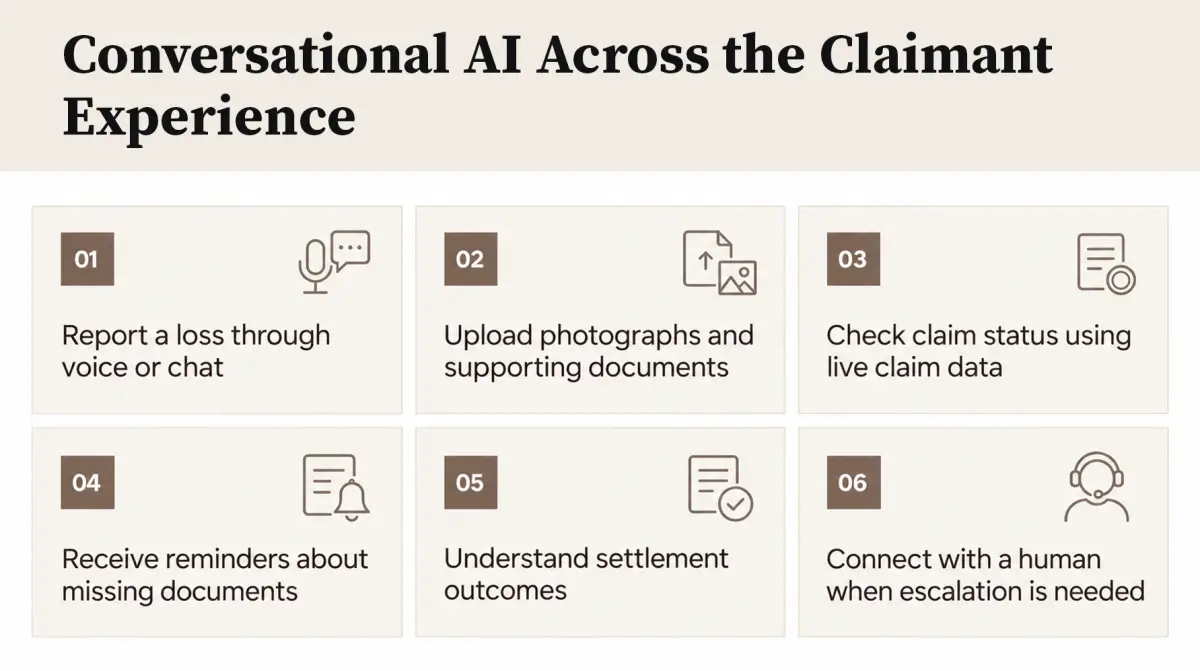
The infographic below illustrates the role of conversational AI in enhancing the claimant experience.
Answer Status Questions from the Live Claim File
A virtual claims assistant answers “Where’s my claim?” from the real, live claim record, not a generic FAQ script. This helps claimants file or track claims anytime, anywhere. They can get structured updates on when:
- The case is transferred to a claim adjuster
- It’s sent for inspection or approval
- A claim is approved, with guidance on next steps
If the record doesn’t answer the question, the assistant says so and routes it to the adjuster rather than guessing. That is self-service claim tracking that cuts calls, because every answer is specific to the claimant’s file.
Draft Correspondence Adjusters Approve
Claims correspondence automation works in both directions. On inbound mail, correspondence classification tags each email or letter by intent (a new document, a complaint, an attorney’s letter of representation, a payment question) and routes it to the right queue. On outbound mail, AI drafts acknowledgements, requests, and status letters from the claim file and approved templates, and tracks state-mandated response timelines so no deadline slips.
Letters that state a position on the claim (coverage letters, reservation-of-rights letters, settlement offers) are drafted from the claim file and approved templates, and the adjuster approves each one. The system tracks state-mandated response deadlines and flags any that are close.
The goal is drafts good enough that the adjuster approves rather than rewrites.
Escalate on Sentiment, Vulnerability, or Complexity
Well-designed AI knows when to step back. Escalation triggers should be explicit: negative sentiment that persists across messages, signs of vulnerability (bereavement, injury, financial hardship), a claimant asking for a person, or a case beyond the assistant’s limits. When a trigger fires, the assistant passes the full conversation history to the human, so the claimant never repeats their story.
“In a more technological era, the human element will become even more important.”
– Michael Müssig, Senior Partner, McKinsey & Company
AI does not need emotional intelligence for these moments. It needs to recognize them and route them to people who have it.
Close Claims with Faster, Explainable Settlements
At settlement, AI assembles the payment package and explains the outcome to the claimant in plain language. Humans make denial decisions. That is both good practice and what regulators increasingly expect.
Settlement is where days are lost to paperwork: the release, the payment authorization, lienholder or mortgagee details, and the final calculation. AI assembles that package from the claim file and checks it for completeness before it reaches an approver. Once approved, payment can go out digitally the same day instead of waiting on a mailed check.
Then it explains the outcome. A claimant who receives a plain-language summary of what was covered, what wasn’t, how the amount was calculated, and how to appeal is less likely to call, complain, or litigate.
For example: “Your policy covers the roof repair at $8,400. After your $1,000 deductible, we’re paying $7,400. The ceiling stain isn’t covered because the inspection found a leak that had continued for months, which your policy excludes. If you disagree, you can request a review here.” The adjuster approves the explanation along with the settlement.
One rule should be non-negotiable: humans make denial decisions. AI can recommend approval and, within pre-set limits, pay. But a denial, reduction, or rescission should always be made and signed by a qualified person.
The NAIC Model Bulletin holds insurers accountable for every decision AI supports, and states are starting to write human review into law. Arizona[4], for example, now requires a medical director to personally review health insurance denials.
Connect AI to the Claims Core You Already Run
AI only improves claims if it reads from and writes to the systems that already run claims: the claims system, the policy administration system, and the CRM. For many carriers, that includes legacy cores on IBM i that will not be replaced soon.
Integration lets every stage in this guide work from the same live record. Policy data, claim status, and correspondence move between systems in real time, so no one keys the same details into three screens.
Many insurers still run policy and claims on IBM i (AS/400), a long-standing IBM business platform. These systems are reliable and hold decades of data, but they were not built to talk to AI services. The practical path is to connect them, not rip them out: expose policy and claim data through secure APIs and keep the core as the system of record.
Damco’s insurance legacy modernization services team works with insurers on exactly this kind of integration, so AI tools can draw on core data without destabilizing it.
Govern AI in Claims Processing Before Examiners Ask
Governing claims AI means documenting where AI is used, what it may decide, how it is tested, and how claimants are told about it, before a regulator asks. In the U.S., that starts with the NAIC Model Bulletin; in Europe, with the EU AI Act’s transparency rules.
Claims involve sensitive details such as health information, address, and other financial data. Chatbots must comply with regulations such as GDPR and HIPAA to protect the interests of the people. AI models must be ethical, responsible, and safe to use.
Prepare for NAIC Bulletin and AI Evaluation Tool Reviews
The NAIC issued its AI Model Bulletin in December 2023 [5]. As of October 2026, 29 jurisdictions have adopted it.[6] The bulletin expects a written AI program covering governance, risk management, testing for unfair outcomes, and oversight of third-party models. Insurers stay responsible for vendor AI as if they had built it.
Next comes the AI Systems Evaluation Tool, which 12 states piloted in market conduct and financial exams in 2026 [7]. The NAIC is targeting adoption at its Fall 2026 National Meeting, putting the tool in examiners’ hands through 2027 [8]. Insurers should be ready to show an inventory of AI systems, risk ratings, and a decision audit trail for any claim AI touched. See our view on AI ethics in claims management.
Disclose AI Interactions to Claimants
Article 50 of the EU AI Act[9], in effect since August 2, 2026, requires that people be told when they are interacting with an AI system, unless it is obvious. In the U.S., state rules vary. Utah, for example, requires regulated businesses to disclose generative AI proactively in high-risk interactions, such as those involving financial or health information. The simplest policy works everywhere: the assistant introduces itself as AI in its first message.
Set What AI May Decide, Recommend, or Never Touch
A three-tier decision boundary makes the rules explicit for adjusters, auditors, and examiners:
| Tier | What AI does | Claims examples |
|---|---|---|
| Decide alone (within set limits) | Acts and logs the action | FNOL acknowledgement, status updates, document requests, fast-track payments under a set ceiling |
| Recommend only | Proposes; a person decides | Severity and litigation scores, reserve suggestions, coverage flags, settlement ranges, fraud referrals |
| Never touch | No role in the decision | Denials, reductions, rescissions, outcomes for vulnerable claimants, final fraud determinations |
Review the boundaries quarterly, and move a task up a tier only when its evaluation results justify it.
Measure What AI Changes in Claims
Measure AI in claims with a short list of operational and experience KPIs, baselined before rollout and tracked by claim type. If a metric cannot be tied to a stage of the claim, it does not belong on the dashboard.
Most AI business cases in claims fail on measurement, not technology. Set a baseline for each KPI before launch and report by line of business and claim type, because a gain in auto glass says nothing about bodily injury.
| KPI | What it tells you | Target direction |
|---|---|---|
| Claim cycle time (FNOL to close) | Overall claims processing efficiency | Down |
| Touchless rate | Share of claims closed with no manual touch | Up, within set limits |
| Extraction accuracy | Share of AI-extracted fields that need no human correction | Up |
| Inbound status calls per claim | Whether self-service claim tracking is working | Down |
| Reopen rate | Whether speed is costing accuracy | Flat or down |
| Escalation rate | Whether the assistant recognizes its limits | Stable; investigate sudden swings |
| CSAT at claim close | How the claimant experienced the AI claims journey | Up |
Read the metrics together. A rising touchless rate alongside a rising reopen rate means the fast-track limits are too loose. Falling status calls alongside falling CSAT may mean the assistant is answering but not helping. The goal is not maximum automation. It is better outcomes at a lower cost per claim.
Conclusion
A conversational AI chatbot in the insurance claims process is no longer a futuristic solution. It’s the present that will set the business apart. For leaders deciding where to begin, four principles hold at every stage:
- Start with high-volume or simple claim types. Instead of a full-fledged deployment, begin with frequent, low complexity claims such as glass, minor auto damage, or travel insurance. Assess the output and customer satisfaction rates, then expand.
- Evaluate, ground, and guard, rather than “train the model.” Today’s systems improve through evaluation sets built from real claims, retrieval that grounds every answer in the policy and claim file, and guardrails that keep the assistant within its tier. Re-run the evaluations whenever a model, prompt, or rule changes.
- Keep a human in the loop. Adjusters own the judgment calls, and humans own every denial.
- Keep selling out of open claims. A claimant waiting on a payout is not a cross-sell opportunity. Offering add-on cover mid-claim erodes trust and invites regulatory scrutiny. Save it for renewal, after the claim is closed.
Done well, AI in claims processing becomes a co-pilot: a system that never sleeps and absorbs the volume, so adjusters can focus on judgment. From filing to settlement, these digital assistants give policyholders greater control over their claims journey.
References:
- [1]: J.D. Power 2026 U.S. Property Claims Satisfaction Study
- [2]: J.D. Power 2025 U.S. Auto Claims Satisfaction Study
- [3]: NAIC’s AI Model Bulletin
- [4]: Arizona
- [5]: NAIC’s AI Model Bulletin
- [6]: AI Model Bulletin State Adoption Map
- [7]: NAIC AI Systems Evaluation Tool Pilot Project Summary
- [8]: NAIC Big Data and Artificial Intelligence Working Group
- [9]: Article 50 of the EU AI Act
Read more from our blog
Tell us what you're working on
A strategist reads every reply and writes back.