
Application Modernization: A Complete Guide to Strategy, Approaches & Best Practices
Key Takeaways:
- Application modernization improves the maintainability, security, scalability, and business value of legacy systems.
- The right modernization strategy depends on application complexity, business criticality, technical debt, and long-term objectives.
- A structured application modernization framework helps enterprises prioritize investments, control risks, and measure progress.
- Common challenges include legacy dependencies, data migration, integration complexity, budget constraints, and skills gaps.
- Modernization costs depend on the application portfolio, selected approach, cloud architecture, testing requirements, and implementation scope.
- Continuous monitoring and optimization help enterprises sustain the benefits of modernization after deployment.
Legacy applications often support the business processes that matter most, from customer transactions and policy administration to financial reporting and supply chain operations. Yet, as business requirements evolve, these systems can become expensive to maintain, difficult to integrate, and slow to change. The result is rising technical debt, operational risk, and missed opportunities for innovation.
Application modernization helps enterprises address these limitations by upgrading application architecture, code, infrastructure, and integrations to meet current business requirements. It can involve moving applications to the cloud, refactoring legacy code, adopting microservices, replacing unsupported software, or rebuilding selected components. The objective is to improve business performance while preserving critical functionality.

The need is increasingly strategic. According to IBM’s1 July 2026 update on application modernization, 83% of C-suite executives consider modernizing applications and data central to their business strategy. For enterprise leaders, the challenge is determining which applications to modernize, which approach to use, and how to deliver measurable results without disrupting business operations.
What Is Application Modernization?
Application modernization is the process of updating existing software applications to improve their architecture, performance, security, maintainability, and ability to support changing business needs. It can involve changes to application code, databases, infrastructure, user interfaces, integration layers, or deployment practices.
Unlike a complete replacement, modernization does not require enterprises to discard everything they already have. Teams can preserve proven business logic while upgrading the components that constrain performance or innovation.
For example, an insurer might retain the core policy administration logic of an established application while introducing modern APIs, a responsive user interface, automated testing, and cloud-based infrastructure. This allows the insurer to improve agent productivity and system integration without immediately rebuilding the entire platform.
Applications that commonly require modernization include:
- Monolithic enterprise applications that tightly couple business functions and make changes difficult to implement.
- Unsupported legacy systems that no longer receive vendor updates or security patches.
- Custom-built applications with accumulated technical debt, limited documentation, or high maintenance requirements.
- On-premises applications that struggle to scale with changing workloads or integrate with cloud services.
- Data-intensive applications that cannot easily support real-time analytics, automation, or AI-enabled workflows.
- Business-critical systems with outdated interfaces that slow employees down and complicate customer interactions.
The modernization objective should be specific to each application. A stable system might need a platform upgrade, while a business-critical application with deeply coupled components might require architectural changes.
Why Is Application Modernization Important for Enterprises?
Modernization becomes a business priority when existing systems begin to constrain growth, increase operational risk, or consume resources that could support new initiatives.
Deloitte’s 2025 Tech Value Survey2 found that 60% to 80% of respondents identified CIOs and CTOs as the primary drivers of technology decisions, with both leaders generally sharing responsibility for legacy modernization, information automation, and business support. While this technical leadership is essential, application modernization also requires broader business alignment. CFOs, chief strategy officers, and CHROs should contribute to decisions that affect investment priorities, workforce capabilities, operational efficiency, and long-term business performance.
Four business pressures commonly drive this investment.
1. Rising Maintenance Costs and Technical Debt
Legacy applications can depend on obsolete frameworks, specialized skills, unsupported components, and manual maintenance processes. As these dependencies accumulate, even small changes may require extensive testing and remediation.
Modernization gives enterprises an opportunity to simplify code, replace unsupported components, automate routine maintenance, and redirect engineering resources toward business improvements.
2. Growing Demands for Agility and Scalability
Customers and business teams expect digital services to respond quickly to changing requirements. Applications built around tightly coupled architectures can make frequent releases difficult because a change in one component may affect several others.
Modernization can introduce modular architecture, automated delivery pipelines, and containerization where appropriate. These changes help teams release updates more independently and scale application components according to demand.
“It’s no longer about one monolithic suite and its deployment, it’s about this continuous wiring and rewiring of the digital feedback loop.”
– Satya Nadella, Chairperson and CEO of Microsoft.
3. Security, Compliance, and Operational Resilience
Outdated software can contain known vulnerabilities, depend on unsupported libraries, and lack modern identity or monitoring capabilities. These weaknesses create additional risks for enterprises handling sensitive customer, financial, or operational data.
A well-planned modernization initiative can introduce supported software versions, stronger access controls, secure integration patterns, automated security testing, and improved disaster recovery. Security requirements must remain part of the design and implementation process, particularly for regulated industries.
4. Integration, Analytics, and AI Readiness
Legacy applications often store valuable business information in formats or structures that are difficult to access from modern platforms. This limits the effectiveness of analytics, workflow automation, and AI initiatives.
Modern APIs, better data architectures, and reliable integration mechanisms can make business information easier to access and govern. However, modernization alone does not guarantee AI readiness. Enterprises must also address data quality, access permissions, governance, and the suitability of specific use cases.
What Are the Main Application Modernization Approaches?
The path to modernizing legacy applications entails a clear strategy and a defined approach to ensure hassle-free transformation. However, there is no universal application modernization strategy. The right choice depends on the business value of the application, its technical condition, the cost of change, and the desired outcome.
The following approaches help enterprises determine how much change each application requires.
| Approach | What It Involves | When It Makes Sense |
|---|---|---|
| Rehost | Move the application to new infrastructure with minimal code changes. | When infrastructure relocation is urgent and architectural changes can wait. |
| Replatform | Move the application while making targeted platform or infrastructure improvements. | When teams need operational gains without a major redesign. |
| Refactor | Restructure existing code to improve maintainability, quality, or performance. | When technical debt slows development and increases maintenance effort. |
| Rearchitect | Redesign the application’s architecture, potentially introducing modular services or cloud-native components. | When scalability, resilience, or integration limitations require deeper changes. |
| Rebuild | Develop a new application while retaining selected business requirements and functionality. | When the existing codebase is too constrained to support future needs. |
| Replace | Adopt a commercial product or SaaS alternative instead of maintaining a custom application. | When an established product can meet requirements more effectively. |
| Retire | Decommission an application that no longer provides sufficient business value. | When functionality is redundant or the application is no longer needed. |
These approaches are related to the broader cloud migration strategies commonly called the 7 Rs. The exact terminology varies across frameworks, but the underlying principle remains the same: evaluate each application individually rather than forcing the entire portfolio into one path.
For example, a stable reporting application may be suitable for rehosting, while a customer-facing platform with frequent release requirements may benefit from refactoring or rearchitecting. An obsolete internal tool may be better retired than modernized.
The decision should reflect expected business value, implementation risk, and the total cost of ownership over the application’s expected lifespan.
What Is the Application Modernization Framework?
A structured application modernization framework translates business objectives into an actionable delivery process. It helps technology leaders assess the current environment, select appropriate modernization methods, validate results, and continuously improve the application portfolio.
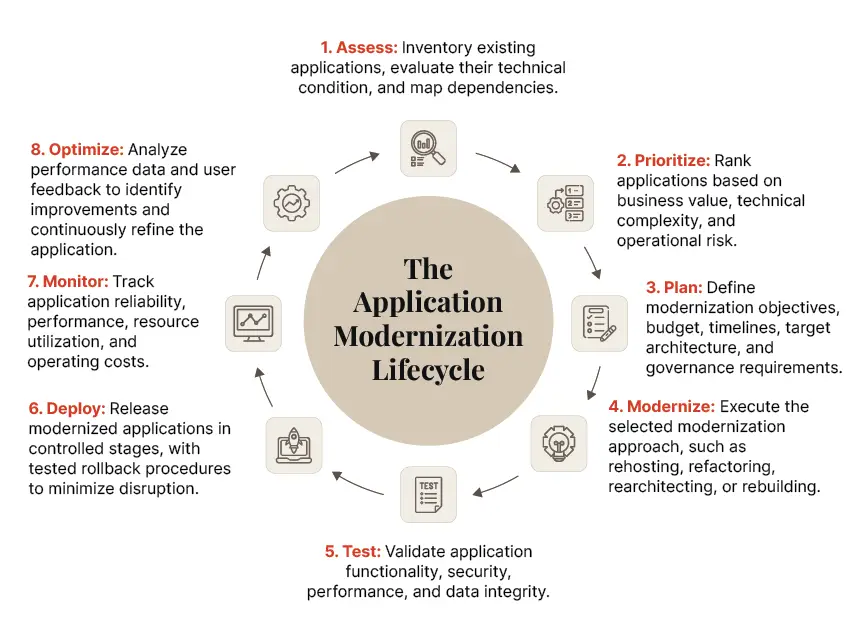
I. Assess the Application Portfolio
Start by documenting the applications in use, their business owners, technical dependencies, support status, infrastructure requirements, security exposure, and maintenance costs. Code analysis and application discovery tools can help reveal hidden dependencies and areas of technical debt.
The assessment should also identify applications that can be retired or replaced. Modernizing every application is rarely the most effective use of resources.
II. Prioritize Applications by Business Value
Rank applications using criteria such as business criticality, customer impact, compliance requirements, operational risk, modernization effort, and expected return on investment.
A high-maintenance application that supports a critical business process may deserve priority. A low-value application with overlapping functionality may be a stronger candidate for retirement.
III. Define the Strategy and Target Architecture
Set measurable objectives before choosing technologies. These might include reducing deployment time, improving availability, lowering support costs, or enabling secure integration with other business platforms.
Select a modernization approach that supports those objectives. Define the target architecture, integration requirements, data handling rules, security controls, and operating model.
IV. Modernize and Validate Incrementally
Implement changes in manageable stages. Where practical, start with a lower-risk application or a well-defined component to validate the architecture, delivery process, and testing strategy.
Automated regression testing, security testing, performance validation, and data reconciliation help teams detect issues before production deployment.
V. Deploy, Monitor, and Optimize
Use controlled releases, staged rollouts, and tested rollback procedures to reduce operational risk. After deployment, monitor application performance, availability, infrastructure consumption, user adoption, and support incidents.
Use the results to determine whether the modernization objectives have been achieved and what improvements should follow.
“Disrupt yourself while you still have the cash flow and clients who value your capabilities.”
– Arvind Krishna, Chairman and CEO at IBM
What Is the Application Modernization Roadmap?
The framework explains the recurring lifecycle. The roadmap translates that lifecycle into a sequence of enterprise implementation phases, with defined outputs and decision points.
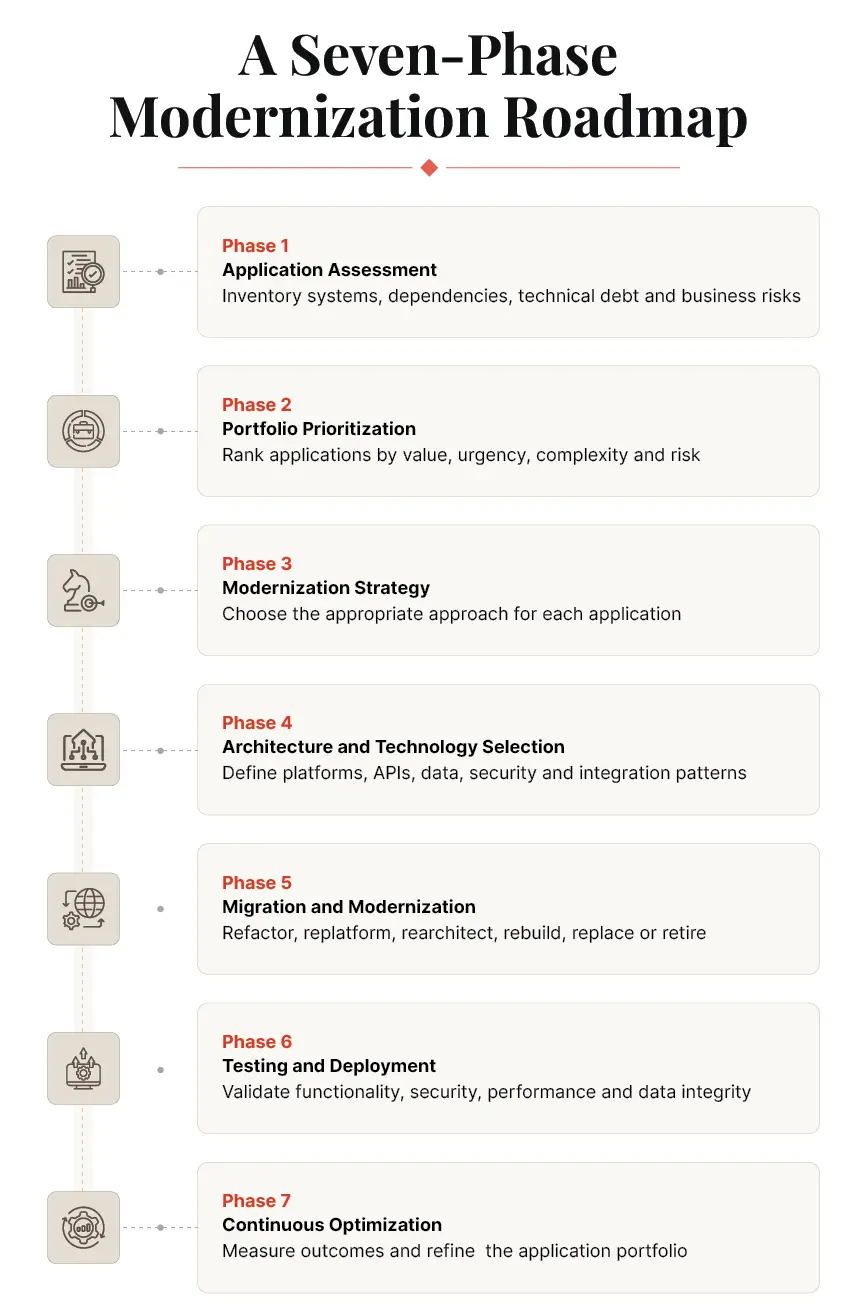
Each phase should have a clear owner, an approved scope, measurable acceptance criteria, and a decision gate before the project progresses.
The roadmap should also account for business calendars, contractual commitments, regulatory deadlines, and dependencies between applications. A phased delivery model gives enterprises opportunities to validate assumptions and adjust the plan before moving to more complex systems.
Best Practices for Executing the Roadmap
- Align modernization with business outcomes. Define success in business terms, such as faster claims processing, shorter release cycles, reduced service interruptions, or lower support costs.
- Preserve critical business logic. Document essential rules and workflows before changing legacy systems. This is particularly important when application behavior reflects years of business-specific decisions that are not fully documented.
- Treat data migration as a separate workstream. Establish data ownership, quality checks, reconciliation rules, retention requirements, and rollback procedures early.
- Build security into every phase. Use secure development practices, least-privilege access, dependency scanning, encryption, and appropriate compliance controls throughout implementation.
- Prepare users and support teams. Involve end users in requirements gathering and testing. Train employees, update operational documentation, and define post-launch support responsibilities.
- Measure results after deployment. Compare actual costs, performance, reliability, and adoption against the baseline established during assessment. Use the evidence to guide subsequent modernization investments.
Common Application Modernization Challenges and How to Address Them
Application modernization can improve business performance, but implementation becomes complicated when enterprises underestimate the constraints within their existing environments. A successful application modernization strategy must address technical, operational, financial, and organizational challenges before they affect delivery.
| Challenge | Business Impact | Recommended Response |
|---|---|---|
| Legacy dependencies | Changes to one component can disrupt connected applications. | Map dependencies, document interfaces, and modernize tightly coupled components in controlled stages. |
| Data migration complexity | Inconsistent records or incomplete transfers can affect business operations. | Profile data, define reconciliation rules, validate migration results, and maintain tested recovery procedures. |
| Technical debt | Outdated code and unsupported components increase maintenance effort. | Identify high-impact debt, prioritize remediation, and introduce coding standards and automated testing. |
| Integration issues | Legacy interfaces may not support modern applications or APIs. | Establish clear API contracts, use integration middleware where appropriate, and test end-to-end workflows. |
| Security risks | Unsupported software and configuration gaps increase exposure. | Apply secure development practices, update dependencies, enforce access controls, and conduct security testing. |
| Skills gaps | Teams may lack expertise in legacy technologies or modern architectures. | Combine knowledge transfer with targeted training and specialist application modernization services. |
| Downtime concerns | Disruption can affect customers, revenue, and service commitments. | Use phased releases, parallel operations where feasible, and tested rollback procedures. |
| Budget constraints | Hidden dependencies and scope changes can increase expenditure. | Estimate costs by application, maintain contingency reserves, and govern changes through formal decision gates. |
| Resistance to change | Employees may avoid or struggle with new workflows. | Involve users early, communicate the business rationale, and provide role-specific training and support. |
These challenges are interconnected. For example, incomplete dependency mapping can lead to unexpected integration work, which increases costs and extends the delivery timeline. Enterprises should therefore assess technical readiness and business readiness together.
How Much Does Application Modernization Cost?
There is no universal price for application modernization. The investment depends on the condition of the existing application, the depth of change required, the target architecture, and the consequences of disrupting business operations.
A straightforward platform upgrade may require limited code changes, while rebuilding a business-critical application with complex integrations can involve substantial engineering, migration, testing, and change-management work.
The following factors have the greatest influence on the overall cost.
- Application complexity: Large codebases, undocumented business rules, tightly coupled components, and obsolete technologies require more assessment and engineering effort.
- Portfolio size: Modernizing several interconnected applications involves more coordination, dependency management, and integration testing than upgrading a standalone system.
- Modernization approach: Rehosting generally requires less application redevelopment than rearchitecting or rebuilding. However, the lowest initial cost may not deliver the best long-term economics.
- Cloud architecture and infrastructure: Hosting, storage, networking, managed services, licensing, observability, and ongoing cloud consumption all contribute to the cost.
- Integrations and data migration: Connecting modernized applications to existing systems and validating large or sensitive datasets can require significant effort.
- Testing and business continuity: Performance testing, security validation, parallel operations, disaster recovery, and rollback preparation add to the project scope.
- Skills and change management: Specialist expertise, knowledge transfer, employee training, and operational support must be included in the estimate.
How to Evaluate Application Modernization ROI
Enterprises should establish a baseline before implementation and compare it with the cost and performance of the modernized application.
A useful starting point is to calculate the total cost of ownership (TCO) over a defined period, including both implementation and ongoing operations.
Total benefits may include reduced maintenance expenditure, lower infrastructure costs, fewer service disruptions, faster releases, improved employee productivity, and avoided costs associated with unsupported systems. Total costs should include implementation, licensing, migration, training, and ongoing operations.
For example, a modernization project that lowers maintenance expenditure may still deliver poor returns if cloud consumption, licensing, or support costs rise sharply. A complete financial assessment should therefore compare expected savings with the full cost of running the new environment.
Executives should also distinguish direct financial returns from strategic benefits. Better integration, improved security, and faster product delivery may create long-term business value even when the immediate savings are modest.
How Can Application Modernization Services Help?
Legacy system modernization often requires expertise across legacy technologies, application architecture, cloud infrastructure, data migration, integration, testing, and ongoing support. Internal teams may have strong knowledge of existing systems but limited capacity to manage all these activities alongside day-to-day operations.
Application modernization services providers can help enterprises assess their application portfolios, identify dependencies, compare modernization options, and build a phased implementation roadmap.
Depending on the business requirements, support may include:
- Application portfolio assessment and modernization planning.
- Legacy code analysis, refactoring, and reengineering.
- Cloud migration and application modernization.
- API development and enterprise application integration.
- Data migration, validation, and reconciliation.
- Automated testing, deployment, and performance optimization.
- Legacy application maintenance and post-modernization support.
The right engagement should begin with a clear understanding of business objectives, existing constraints, and measurable outcomes. Enterprises should also establish ownership, knowledge-transfer expectations, security responsibilities, and acceptance criteria before implementation begins.
Case Study: How Damco Modernized a Healthcare Company’s Legacy AS/400 System
Application modernization tools deliver measurable business value without discarding critical business logic. Damco’s work with a Texas-based healthcare company demonstrates how modernizing a legacy patient record system can improve usability, scalability, and operational efficiency.
Company Overview
A Texas-based healthcare company supplying medical devices and skincare products to the plastic surgery, dermatology, and aesthetics industries.
The company relied on an AS/400-based electronic patient record system to support its operations.
Business Problem
The legacy system used a green-screen interface and terminal emulators, making the application difficult to use.
Training sales representatives was time-consuming and complicated by the outdated interface.
Limited scalability and integration difficulties restricted the system’s ability to support evolving business requirements.
The client needed a modern user interface while preserving existing functionality and business logic.
Solution
- Damco developed and deployed a fully integrated, platform-independent solution using the latest version of IBM i.
- Rebuilt the user interface using modern front-end technologies without disrupting transcription and document management activities.
- Reimplemented critical process workflows and document management capabilities.
- Re-architected clinic and hospital applications for the cloud using a microservices architecture.
- Enabled online and offline application access to support operational continuity during server or network downtime.
- Implemented data encryption and healthcare compliance measures to protect sensitive patient information.
Results
- 7.5% increase in profits following AS/400 modernization.
- US$2.5 million in ROI within seven months of application modernization.
- Over 57% cost savings through the offshore engagement model.
- Approximately 10% improvement in transcriptionist productivity, supported by internal messaging.
- Improved scalability and the ability to handle high-load traffic through a more flexible application architecture.
Summing Up
Application modernization is a strategic investment in the systems that support enterprise operations, customer relationships, and future growth. The objective is to make applications more adaptable, secure, and cost-effective while preserving the business capabilities that continue to deliver value.
A disciplined application modernization roadmap helps enterprises prioritize the right systems, choose appropriate technologies, manage implementation risks, and measure results. The process also requires ongoing monitoring and optimization to ensure modernized applications continue to meet evolving business needs.
Our application modernization services help organizations assess legacy environments, develop tailored modernization strategies, and execute application transformation initiatives. With the right combination of domain knowledge, technical expertise, and phased delivery, enterprises can reduce legacy constraints while building a stronger foundation for digital transformation.
References:
Read more from our blog
Tell us what you're working on
A strategist reads every reply and writes back.