
An agent is a short loop with a written reach Six building blocks, one gateway, and a list of what it may touch
Damco builds every agent as one loop: observe, reason, act, and verify. Your team writes the list of what the agent may reach. Anything not on the list doesn't exist for it.
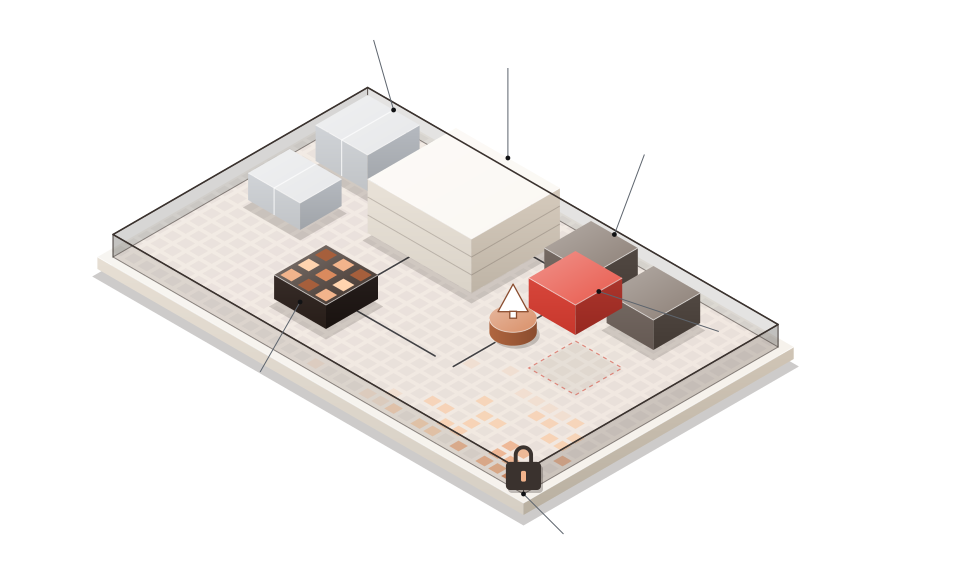
Every action passes through one gateway The gateway decides what the agent gets, and records what it did
Your people
ReviewersReview surfaceApprovals
The agent
ObserveReasonActVerify
What it may reach
Tool listBrowserRead modelPast corrections
The gateway
Who may actA record of every actionRead-only copies
What you already run
Core systemERPCRMData warehouse
Here is one agent action, end to end The loop repeats until the job is done, or until it escalates
- Step 1ObserveThe agent reads the case and the material behind it.
- Step 2ReasonIt prepares a decision with the tools on its list.
- Step 3ActThe gateway checks each call and writes it to the record.
- Step 4VerifyA reviewer approves before any change is committed.
Six blocks make up every agent we deploy We build four, choose the fifth with you, and measure the sixth
Review work where your team already isA console built for the role, or the collaboration tool you use. You can change this later at low cost.
Agree what your business terms meanWe map only the terms the job touches, and which system holds the true definition.
Send every action through one gatewayIt decides what each agent may do, records every action, and can serve read-only data.
Run the agent where your data must stayA managed service, an instance destroyed after the job, or a person's workstation.
Keep every reviewer correctionEach correction becomes a signal you can measure, not rework nobody sees.
Measure from the first releaseCorrection rate, escalation rate, and the job's business number, against a baseline taken first.
Four patterns cover almost every deployment Each one changes what the agent can reach, not the design
Work a queue your team ownsIt reaches only its tool list, through the gateway. Claims intake, prior authorization, and RFQ response.
Answer from a copy, never the originalYour system of record is never contacted. Chart preparation, lane quoting, and month-end close.
Research outside your wallsIt uses public sources only, so nothing inside is opened. Due diligence and supplier research.
Change code and submit it for reviewIt runs on a machine we create for the job and destroy after it, with no route to production.
Your hardest rules each map to one block We find them at the start, not at the end
Keep the core you can't replaceNo agent writes inside your system of record. Every action goes through the gateway.
Let a regulator rebuild any decisionEvery case keeps its reasoning, and every action has a record from the first release.
Keep data inside your tenancyThe gateway controls what leaves, and the runtime can sit in your own cloud.
Spare your team another toolReview happens in the platform your team already uses.
Use the AI spend you've committedWe check your licenses first. If your agreement covers the runtime, we don't bill for it.
A reviewer stays until the corrections say otherwise Both stages are the same build, switched at the gateway
- First releaseReviewedA reviewer approves every case, and we keep each correction.
- When corrections stay lowPromotedAutonomy grows when the correction rate stays under a figure you set, for weeks you set.
- After thatDelegatedThe agent works inside a written limit. A reviewer checks a sample and every exception.
Describe one job, and we'll name the pattern
We'll tell you the blocks it needs and the systems it must reach, or that it doesn't need an agent.